 Tech Venture Lab
Let's turn your idea into a product people rely on
Tell us about your project. We'll reply within one business day with a clear next step, scope, and timeline.
Tell us about your project. We'll reply within one business day with a clear next step, scope, and timeline.
8 min readTech Venture Lab
You can have a great product, a strong marketing campaign and a fast website, and still lose customers because the experience feels confusing. Visitors decide quickly whether a digital product is easy, trustworthy and worth their time. Good UI/UX design is what turns that first impression into action.
This guide explains the core principles behind interfaces that convert, and how to apply them to your website, web app or mobile product.
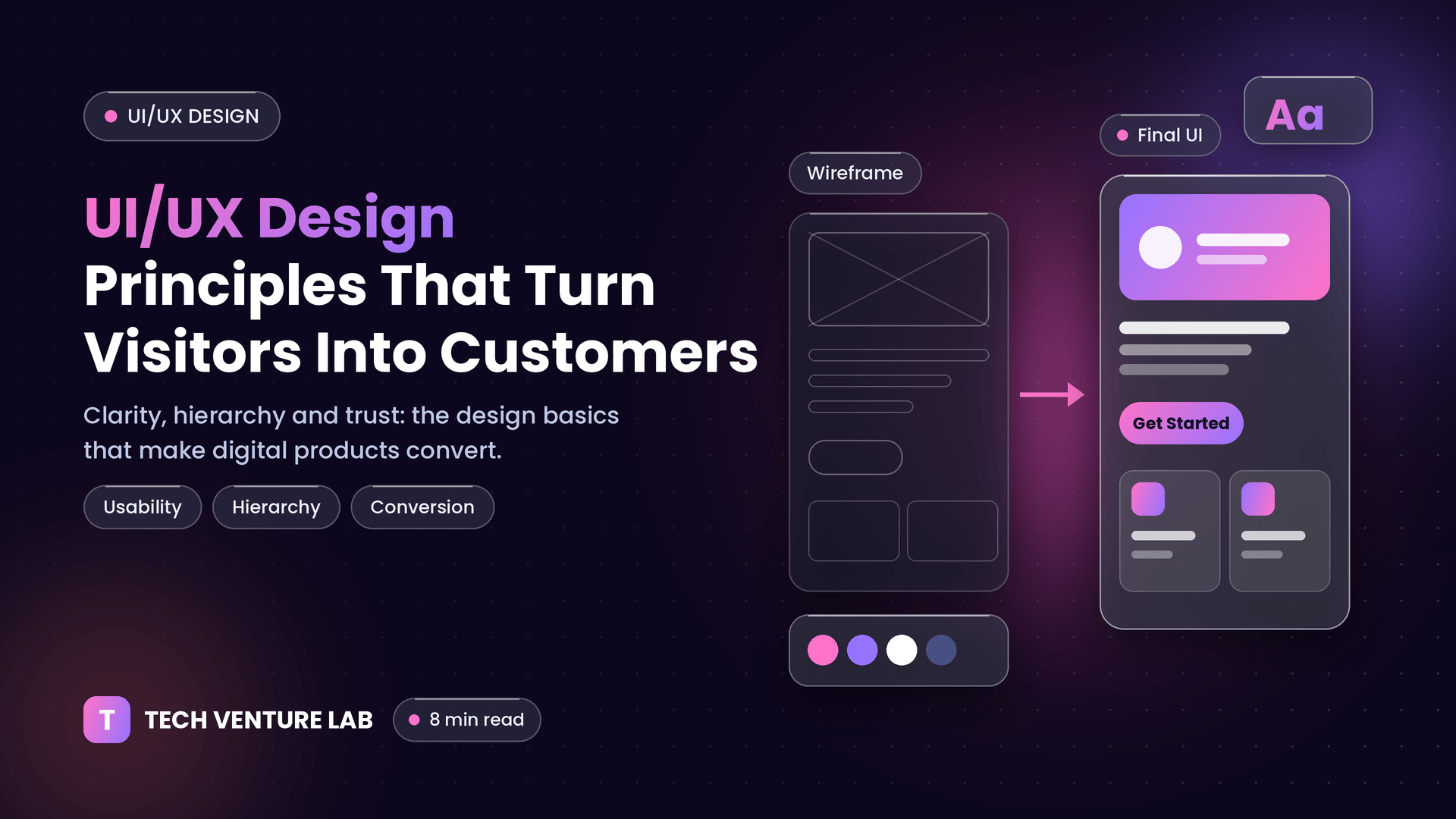
UX decides whether the product works well for people. UI decides how it looks and feels while they use it. Strong products need both.
Design is not decoration. It influences:
Before designing, understand who your users are, what they are trying to achieve and what stops them. Interviews, surveys, analytics and usability tests reveal real behaviour that internal assumptions often miss.
Every extra element competes for attention. Remove anything that does not help the user reach their goal. Use plain language, short sentences and obvious labels instead of clever wording.
Users scan before they read. Guide their eyes with size, contrast, spacing and position so the most important elements, such as the headline, value proposition and main button, stand out first.
Each page should have one primary action. Use a visually distinct button with specific, benefit-oriented text such as "Start free trial" or "Get a quote" rather than vague labels like "Submit". Place it where users naturally look for the next step.
Use the same patterns for buttons, colors, spacing, icons and navigation across the product. Consistency reduces the effort of learning, builds familiarity and makes the product feel reliable. A design system helps teams maintain it.
A large share of visits come from phones. Design layouts that work on small screens first, with touch-friendly buttons, readable text and thumb-reachable navigation, then expand for larger screens.
A beautiful interface that loads slowly loses users. Compress images, limit heavy scripts, use modern formats and aim for fast, stable loading. Performance is part of the user experience.
Forms are where many conversions are lost. Ask only for essential information, use clear labels and helpful error messages, support autofill, and show progress in multi-step flows. Every unnecessary field adds friction.
People hesitate when they are unsure. Support decisions with clear pricing, honest descriptions, customer testimonials, recognizable security indicators, accessible contact details and transparent policies. Place trust signals near moments of decision, such as sign-up and payment.
Accessible design helps everyone, including people with visual, motor, hearing or cognitive differences. Provide sufficient color contrast, readable font sizes, keyboard navigation, descriptive alt text and clear focus states. Following the WCAG guidelines is both good practice and, in many regions, a legal expectation.
A reliable process reduces guesswork:
Useful metrics include conversion rate, bounce rate, task completion rate, time on task, drop-off points in funnels, user satisfaction scores and support ticket volume. Pair numbers with qualitative insight from usability sessions, since data shows what happens and users explain why.
At Tech Venture Lab, we treat design as a strategic part of building digital products. Our approach combines user research, thoughtful UX, modern UI and close collaboration with engineering, so what we design is not only attractive but also practical, scalable and conversion-ready.
Want an interface your customers love to use? Get in touch and let's improve your product experience.
Great design is clarity in action. When your product is simple to understand, quick to use, consistent and trustworthy, visitors feel confident and take the next step. Apply these principles, test with real users and keep improving, and your design will become one of your strongest growth tools.