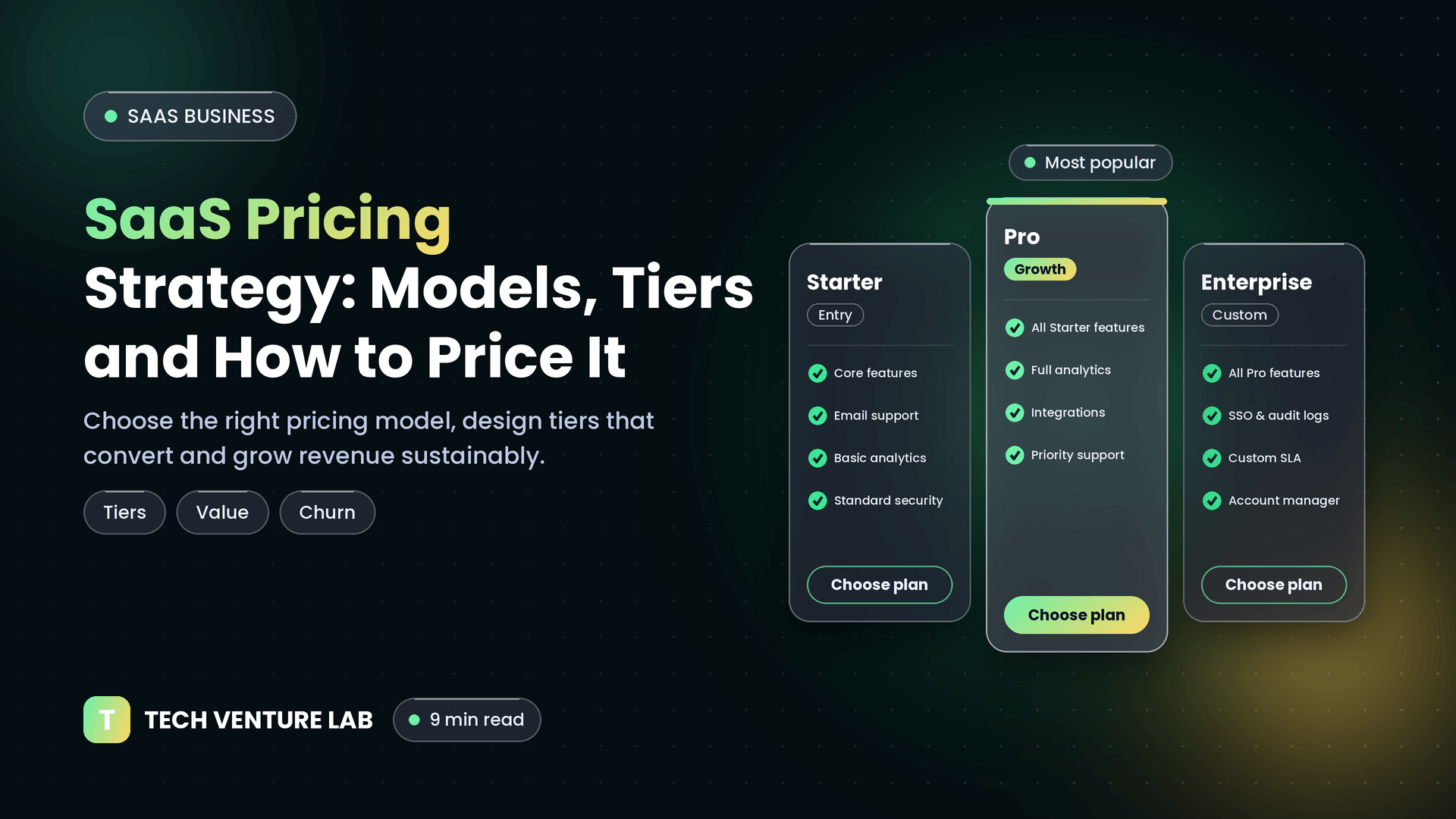
SaaS Pricing Strategy: Models, Tiers and How to Price Your Product
·9 min read·Tech Venture Lab
Founders often spend months perfecting a product and about an hour deciding its price. Yet pricing is one of the most powerful levers in a SaaS business. It shapes who your customers are, how fast you grow, how much revenue you keep and how your product is perceived in the market.
A good pricing strategy is not a number copied from a competitor. It is a deliberate system that connects the value you deliver to the way customers pay. This guide explains the main pricing models, how to design tiers and a step-by-step process to set and improve your prices.
Why Pricing Matters So Much
Revenue impact: Small improvements in pricing can affect revenue more than similar improvements in acquisition.
Positioning: Price signals quality. Too low can suggest an unserious product; too high without proof of value creates friction.
Customer fit: Pricing attracts or repels certain customer types, which influences support load, churn and product direction.
Growth mechanics: The model you choose determines how revenue expands as customers succeed.
Sustainability: Prices must cover the real cost of serving customers, including infrastructure, support and acquisition.
The Main SaaS Pricing Models
1. Flat-rate pricing
One product, one price, one set of features.
Pros: Very simple to explain and sell; easy to forecast.
Cons: Leaves money on the table from larger customers; may price out smaller ones.
Best for: Simple products with a uniform customer base.
2. Tiered pricing
Several plans (for example Starter, Pro and Enterprise) with increasing features, limits and support.
Pros: Serves different segments; clear upgrade path; the most common SaaS model.
Cons: Needs careful packaging; too many tiers confuse buyers.
Best for: Products with varied customer sizes and needs.
3. Per-user (per-seat) pricing
Customers pay for each user or seat.
Pros: Easy to understand; revenue grows as the customer's team grows.
Cons: Can discourage adoption inside a company; may not reflect actual value if value does not scale with users.
Best for: Collaboration and productivity tools where value grows with team size.
4. Usage-based pricing
Customers pay according to consumption, such as API calls, storage, transactions or messages sent.
Pros: Aligns cost with value; low barrier to start; revenue scales with customer success.
Cons: Less predictable for both sides; requires solid metering and billing systems.
Best for: Infrastructure, communication, payments and data products.
5. Feature-based pricing
Different features are unlocked at different price points, often combined with tiers.
Pros: Customers pay for what they need; supports natural upsells.
Cons: Risk of withholding features that users consider essential.
Best for: Products with distinct modules or advanced capabilities.
6. Freemium
A free plan with limited features or usage, with paid upgrades.
Pros: Low-friction acquisition; strong for viral or product-led growth.
Cons: Free users cost money to serve; conversion rates can be low if the free tier is too generous.
Best for: Products with large addressable markets and a clear upgrade trigger.
7. Free trial
Full access for a limited time, followed by a paid plan.
Pros: Customers experience real value; commonly leads to higher intent users.
Cons: Requires strong onboarding; users may churn after the trial if value is not reached quickly.
Best for: Products where value is clear within days or weeks.
8. Hybrid models
Many modern SaaS companies combine approaches, such as a base subscription plus usage-based overages, or tiers with per-seat pricing.
Quick Comparison
Model
Simplicity
Predictability
Scales with customer success
Typical fit
Flat-rate
Very high
High
Low
Simple tools
Tiered
High
High
Medium
Most SaaS products
Per-user
High
High
Medium (with team size)
Collaboration tools
Usage-based
Medium
Lower
Very high
APIs, infrastructure
Freemium
High
Varies
Depends on conversion
Large, self-serve markets
Three Ways to Think About Setting a Price
Cost-plus pricing
Calculate your costs and add a margin. This sets a floor, but it ignores how much customers value the product, so it rarely finds the best price.
Competitor-based pricing
Compare with alternatives in the market. Useful as context, but copying competitors assumes they got it right and that your product, customers and costs are identical.
Value-based pricing
Price according to the value customers receive, such as time saved, revenue gained or risk reduced. This is generally the strongest approach, because it ties price to outcomes. If your product saves a team many hours of work each month, your price can reflect a share of that value.
Best practice: use cost as the floor, competitors as context and customer value as the guide.
How to Design Pricing Tiers
Define customer segments. Group customers by size, needs and willingness to pay.
Choose a value metric. This is the unit that best reflects the value customers get, such as users, projects, contacts, transactions or storage. A good value metric grows as the customer gets more benefit.
Package features by segment. Put the essentials in the lowest tier, the features that serve growing teams in the middle, and advanced security, compliance and support in the top tier.
Keep it simple. Three or four tiers are usually enough. Too many options cause decision paralysis.
Make the middle tier attractive. Many companies design the mid-level plan as the best fit for the majority, and highlight it as the recommended choice.
Create clear upgrade triggers. Customers should naturally outgrow a tier through usage limits, team size or needed capabilities.
Offer an enterprise option. Larger buyers often need custom contracts, security reviews, single sign-on and service-level agreements. "Contact us" pricing is common at this level.
Step-by-Step: How to Set Your First Price
Step 1: Understand your customer and their alternatives
Interview potential customers. What do they use today? What does the problem cost them in time, money or risk?
Step 2: Quantify the value
Estimate the benefit of your product in concrete terms. Pricing conversations become easier when you can show a clear return.
Step 3: Gather price signals
Ask customers directly about price expectations. Methods such as willingness-to-pay surveys and structured price sensitivity questions can help you find acceptable ranges.
Step 4: Choose a model and a value metric
Match the pricing model to how customers use and benefit from your product.
Step 5: Set initial prices and test
Launch with a reasonable hypothesis, then learn. Early customers are a source of feedback, not a fixed commitment to underpricing forever.
Step 6: Track the right metrics
Monitor conversion rates, average revenue per account, churn, expansion revenue, customer acquisition cost and lifetime value.
Step 7: Iterate regularly
Review pricing at least once or twice a year. Product value, competition and customers change, and your pricing should keep pace.
Designing an Effective Pricing Page
Make plans easy to compare with a clear table and consistent feature names
Highlight the recommended plan
Use plain language rather than internal jargon
Show monthly and annual options, with a clear incentive for annual billing if you want to improve cash flow and retention
Answer common questions about billing, cancellation and security on the page
Build trust with testimonials, logos or security badges where appropriate
Provide a clear call to action for each plan, such as "Start free trial" or "Talk to sales"
Billing and Technical Considerations
Pricing is not only a business decision; it must also be implemented in software. Plan for:
Subscription management: plans, upgrades, downgrades, proration and cancellations
Metering and limits: accurate tracking of usage for usage-based or limit-based plans
Payment processing and invoicing: taxes, multiple currencies and regional payment methods
Entitlements: controlling which features each plan can access
Dunning: handling failed payments gracefully
Analytics: clear reporting on revenue, churn and expansion
A flexible billing architecture makes it far easier to experiment with pricing without rewriting your product.
Common SaaS Pricing Mistakes
Pricing too low out of fear. Low prices can attract price-sensitive customers and make growth harder to fund.
Copying competitors blindly
Too many plans and options
Choosing a value metric that punishes success, such as one that penalizes customers for using the product more
Hiding pricing entirely for products that could be self-serve
Never revisiting prices as the product matures
Giving heavy discounts too easily, which trains customers to expect them
Ignoring the cost to serve, leaving some plans unprofitable
Making changes without communication, which erodes trust with existing customers
Changing Prices Without Losing Customers
If you need to raise prices or restructure plans:
Communicate early, clearly and honestly, explaining the added value
Consider grandfathering existing customers for a period
Introduce new prices for new customers first, and measure the response
Pair price increases with visible improvements
Offer annual plans to lock in existing rates when appropriate
Build Your SaaS Product With Tech Venture Lab
At Tech Venture Lab, we build SaaS platforms with the foundations that pricing depends on: flexible subscription billing, plan-based feature access, usage metering, analytics dashboards and scalable architecture. We help you launch quickly, test pricing models and evolve them as your product grows.
Planning a SaaS product?Book a free consultation and let's design the product and the business model together.
Frequently Asked Questions
Conclusion
Great SaaS pricing connects value, customers and business goals. Choose a model that matches how your customers benefit, design simple and clear tiers, test with real users and keep improving. Pricing is not a one-time decision but an ongoing part of building a healthy, scalable SaaS business.
 Tech Venture Lab