 Tech Venture Lab
Let's turn your idea into a product people rely on
Tell us about your project. We'll reply within one business day with a clear next step, scope, and timeline.
Tell us about your project. We'll reply within one business day with a clear next step, scope, and timeline.
8 min readTech Venture Lab
Every business has processes that eat time: copying data between systems, processing forms, reconciling records, answering routine requests. Two technologies are commonly used to automate this work: Robotic Process Automation (RPA) and AI automation.
They are often mentioned together, sometimes confused and frequently mis-sold. Choosing the wrong one can lead to fragile automations that break constantly, or to over-engineered AI projects that were never needed. This guide explains how each works, where each shines and how they combine.
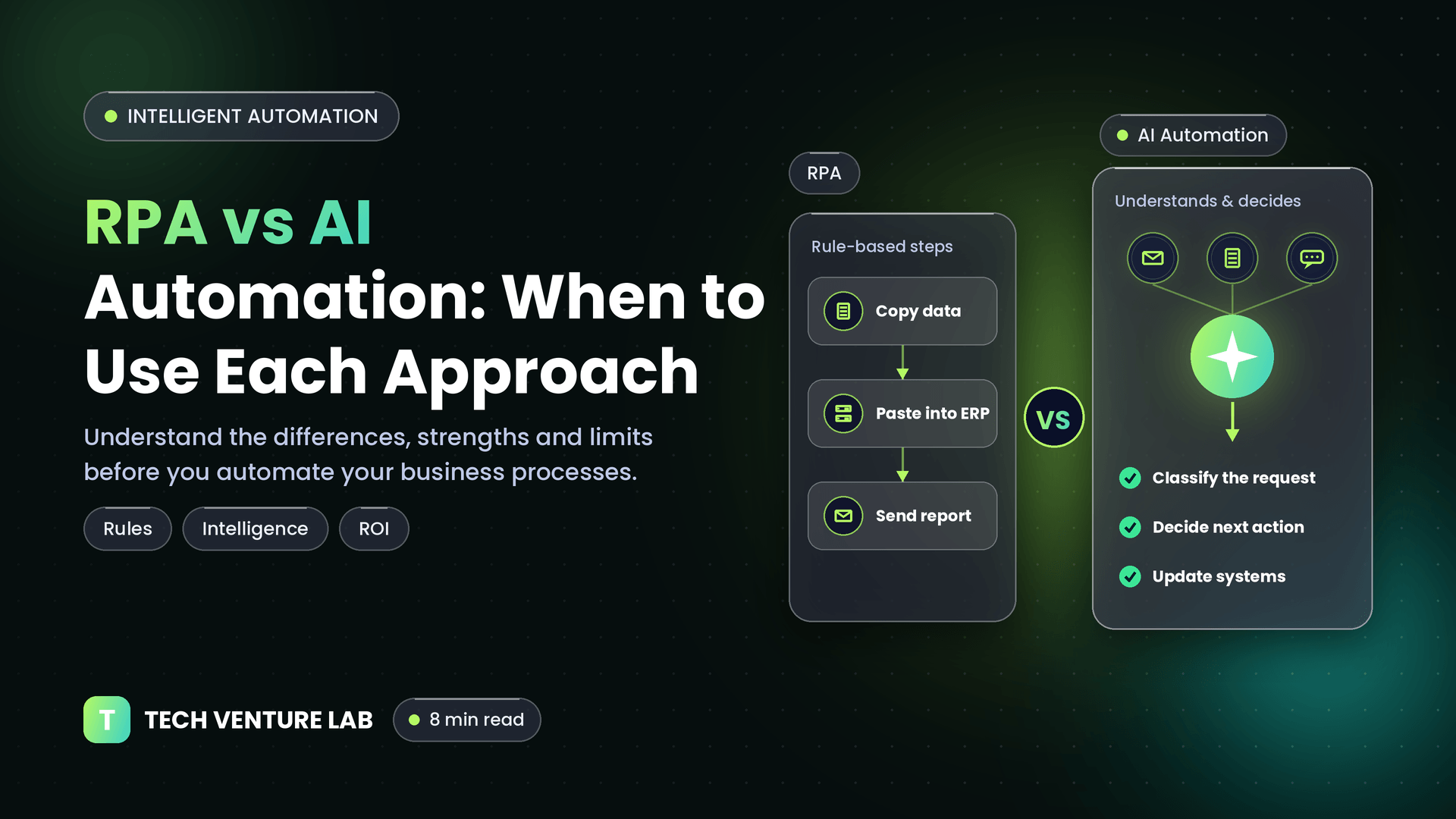
Robotic Process Automation uses software "bots" to mimic the actions a person performs on a computer: clicking buttons, copying and pasting data, filling in forms, opening files and moving information between applications. RPA follows explicit, predefined rules.
Think of RPA as a very fast, tireless digital worker that does exactly what it has been told, in exactly the order it has been told.
AI automation uses artificial intelligence, such as machine learning, natural language processing and large language models, to handle tasks that involve understanding, judgement and variability. Instead of following fixed rules only, AI systems can read and interpret text, classify items, extract information from messy documents, predict outcomes and generate responses.
| Aspect | RPA | AI Automation |
|---|---|---|
| Core approach | Follows fixed rules and scripts | Learns patterns, interprets and decides |
| Input data | Structured, consistent | Structured and unstructured (text, documents, images, speech) |
| Handles variation | Poorly | Well, within limits |
| Typical tasks | Data entry, copy and paste, report generation, system updates | Document understanding, classification, summarization, conversation, prediction |
| Decision-making | Simple, rule-based | Probabilistic, context-aware |
| Setup | Quick for stable processes | More design, data and testing |
| Predictability | Very high | Lower; needs monitoring and guardrails |
| Maintenance risk | Breaks when interfaces change | Needs ongoing evaluation and updates |
| Best for | Repetitive, high-volume, rule-based tasks | Tasks involving language, documents, judgement and variability |
Scenario 1: Transferring daily sales data from a spreadsheet into an old ERP system. Same steps, same format, every day. RPA (or a direct integration) is ideal.
Scenario 2: Processing supplier invoices that arrive as PDFs, scans and emails in many layouts. Variable layouts need understanding. AI document processing extracts data, and RPA or an integration can then post it into the accounting system.
Scenario 3: Handling customer support emails. The content varies widely. AI can classify the request, draft an answer and extract details, with a human reviewing complex or sensitive cases.
Scenario 4: Employee onboarding with defined steps across several systems. Mostly structured and rule-based. Workflow automation or RPA works well, with AI possibly assisting with questions or document checks.
Scenario 5: Reconciling payments with orders. Rules handle most matches; AI can help resolve ambiguous items and flag anomalies. A combination is strongest.
In practice, the most effective solutions combine technologies. This is often called intelligent automation (or hyperautomation when done at larger scale).
A typical combined flow:
Each technology does what it does best, and humans handle what requires judgement and accountability.
RPA is often used because it is quick, but if your systems offer APIs or integration options, direct integration is usually more reliable, faster and easier to maintain than simulating clicks on a screen. RPA is most valuable when no good integration exists, such as with legacy applications. Always check what integration options are available before choosing screen-based automation.
Ask these questions about the process you want to automate:
At Tech Venture Lab, we design and build AI solutions and intelligent automation systems that match the real shape of your processes. Sometimes a clean integration is the best answer; sometimes AI document understanding or an agent-based workflow creates the biggest gains. We focus on reliability, security and measurable results, so automation becomes a dependable part of your operations.
Want to find your best automation opportunities? Talk to our team and we will help you map and prioritize them.
RPA and AI automation are not competitors; they are tools for different kinds of work. Use rules and RPA for structured, repetitive tasks, AI for understanding and judgement, and integrations wherever APIs exist. Combine them thoughtfully, keep humans in the loop and start with a focused pilot. That is how automation delivers lasting value instead of fragile shortcuts.