 Tech Venture Lab
Let's turn your idea into a product people rely on
Tell us about your project. We'll reply within one business day with a clear next step, scope, and timeline.
Tell us about your project. We'll reply within one business day with a clear next step, scope, and timeline.
9 min readTech Venture Lab
Few technical decisions spark as much debate as this one: Should we build a monolith or use microservices? Trends and conference talks often make microservices sound like the obvious modern choice. In reality, many successful products started as monoliths, and many teams have suffered by adopting microservices too early.
The truth is that architecture is a trade-off, not a trophy. This guide explains both approaches in practical terms so you can choose what fits your product, team and stage of growth.
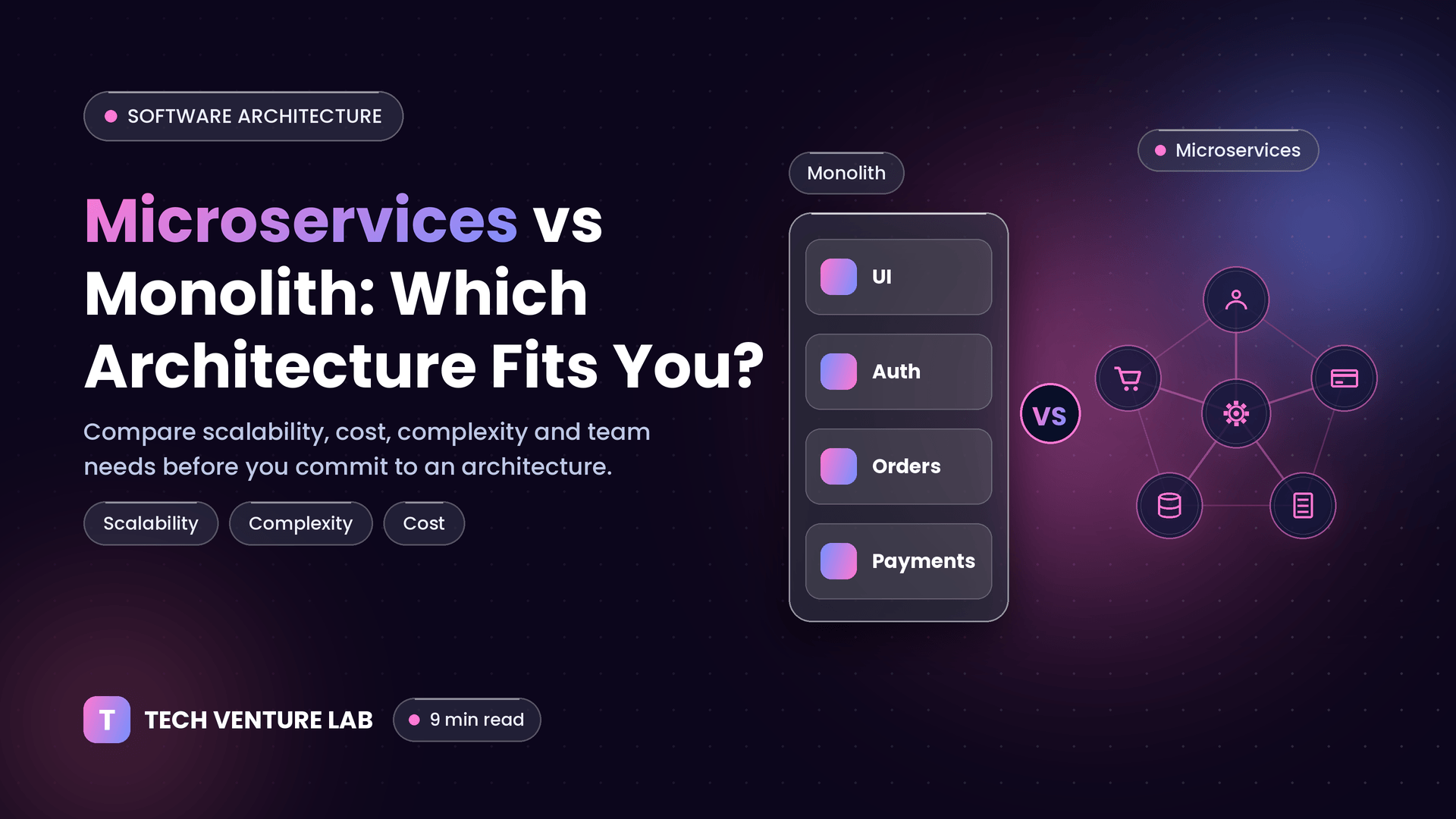
In a monolith, the whole application is built and deployed as a single unit. The user interface, business logic and data access live in one codebase, usually sharing one database. If you change something, you rebuild and redeploy the entire application.
Example: An online store where product catalog, orders, payments and user accounts are all modules inside one application.
Microservices split an application into small, independent services, each responsible for a specific business capability, such as users, orders, payments or notifications. Each service can be developed, deployed and scaled separately and communicates with others through APIs or messaging.
| Factor | Monolith | Microservices |
|---|---|---|
| Initial development speed | Faster | Slower (more design and setup) |
| Deployment | Single unit | Independent per service |
| Scalability | Scale the whole app | Scale individual services |
| Complexity | Low at first, grows with size | High from the start |
| Team size fit | Small to medium | Medium to large, multiple teams |
| Technology flexibility | Limited | High |
| Fault isolation | Lower | Higher |
| Data consistency | Simple, transactional | Harder, often eventual consistency |
| Operations and DevOps need | Moderate | Significant |
| Cost (early stage) | Lower | Higher |
There is a third option that many teams overlook. A modular monolith is a single deployable application that is internally organized into well-defined, loosely coupled modules with clear boundaries.
Why it is attractive:
For many startups and growing products, a well-structured modular monolith is the smartest starting point.
If you start with a monolith and later outgrow it, you do not need a risky "big rewrite". A common approach is the strangler pattern:
Each step delivers value and can be rolled back if needed.
If most answers point to small team, uncertain domain, limited ops capacity, start with a monolith, ideally modular. If they point to multiple teams, clear boundaries, varied scaling and mature DevOps, microservices become compelling.
At Tech Venture Lab, we design architectures around your business goals, not around trends. Whether you need a fast, well-structured MVP, a scalable SaaS platform or a gradual migration to services, we help you make decisions that stay maintainable as your product grows.
Unsure which architecture fits your product? Book a free consultation and we will review your needs together.
The best architecture is the one that fits your current stage, team and goals, while leaving room to evolve. Start simple, keep boundaries clean, invest in good engineering practices, and split into services when the benefits clearly outweigh the cost. Good architecture is not about using the most advanced pattern; it is about solving your real problems effectively.