 Tech Venture Lab
Let's turn your idea into a product people rely on
Tell us about your project. We'll reply within one business day with a clear next step, scope, and timeline.
Tell us about your project. We'll reply within one business day with a clear next step, scope, and timeline.
8 min readTech Venture Lab
Every successful digital product started as an idea. But between an idea and a product people actually use, there is a lot of uncertainty: Will anyone want this? What should we build first? How much should we spend?
The answer to these questions is the Minimum Viable Product (MVP): the simplest version of your product that delivers real value and lets you learn from real users. This guide walks you through the process step by step.
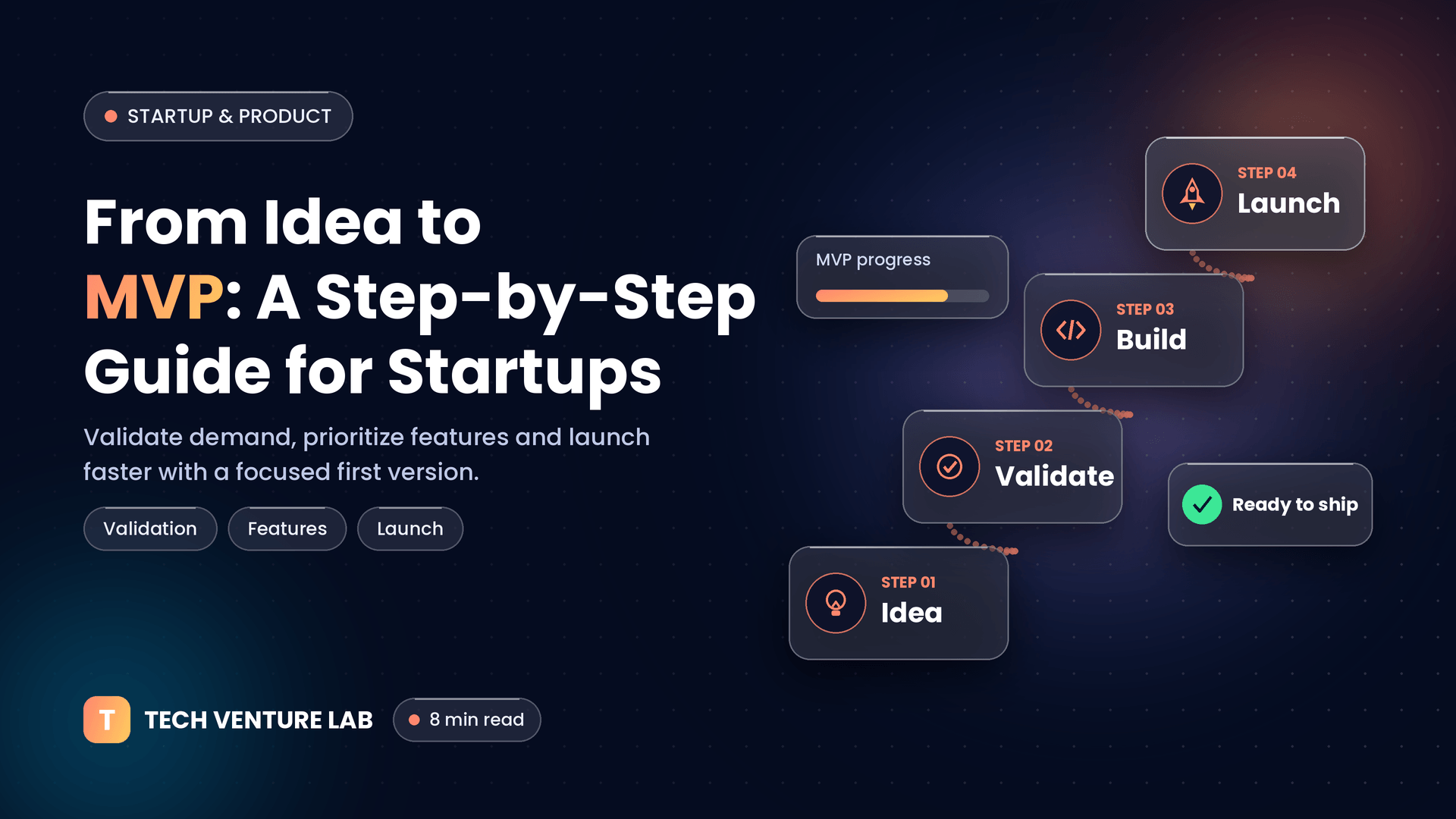
An MVP is not a low-quality or unfinished product. It is a focused product that includes only the core features needed to solve one key problem for a specific group of users.
The purpose of an MVP is to:
Start with the problem, not the solution. Ask:
Write a one-sentence problem statement, for example: "Small clinics struggle to manage appointments and patient reminders without expensive software." Clarity here guides every later decision.
Validation saves months of wasted effort. Practical methods include:
If people are not interested at this stage, you have saved a lot of time and money by finding out early.
Define the one main outcome your product delivers. A strong value proposition answers: What does the user get, and why is it better than the alternative?
Everything in your MVP should support this single promise.
List every feature you can imagine, then sort them:
| Category | Meaning | Action |
|---|---|---|
| Must-have | The product does not work without it | Build in the MVP |
| Should-have | Valuable but not essential | Plan for a later release |
| Nice-to-have | Pleasant extras | Backlog |
| Not needed | Does not support the core value | Remove |
A helpful rule: if you can launch without a feature and still solve the core problem, leave it out for now.
An MVP can be small, but it should not be confusing. Focus on:
Wireframes and clickable prototypes help you test the experience before development begins.
Pick technology that supports speed now and growth later:
Avoid over-engineering, but also avoid shortcuts that make future scaling painful. A clean architecture and well-structured code are worth the small upfront effort.
Break development into short iterations (often 1 to 2 weeks) with working software at the end of each. This approach lets you:
Even a small product must be reliable. Test for functionality, usability, performance, security basics and compatibility across browsers and devices. A buggy first impression is hard to recover from.
You do not need a massive launch. Start with a small group of early adopters, such as people from your interviews or waitlist. They are more forgiving, more engaged and more likely to give honest feedback.
After launch, watch what users actually do, not just what they say. Track:
Use these insights to decide whether to improve, pivot or scale.
Timelines depend on complexity, but a typical journey looks like this:
Clear requirements and quick decisions are the biggest factors in staying on schedule.
At Tech Venture Lab, we help founders and businesses turn ideas into scalable, reliable digital products. From product strategy and UI/UX to web, mobile and SaaS development, we guide you through every stage, so you launch faster, learn sooner and build with confidence.
Have an idea you want to bring to life? Get in touch and let's plan your MVP.
Building an MVP is about learning fast, spending wisely and focusing on what matters most. Validate the problem, build the essentials, launch to real users and let their feedback guide your next move.