 Tech Venture Lab
Let's turn your idea into a product people rely on
Tell us about your project. We'll reply within one business day with a clear next step, scope, and timeline.
Tell us about your project. We'll reply within one business day with a clear next step, scope, and timeline.
8 min readTech Venture Lab
Choosing a software development company is one of the most important decisions you will make for your product. The right partner can accelerate your launch, improve quality and become a long-term extension of your team. The wrong one can mean missed deadlines, budget overruns, poor code and a product that is expensive to fix.
Most failed projects do not fail because of technology. They fail because of poor communication, unclear expectations or a mismatch between client and vendor. This guide gives you a practical framework to avoid those problems.
Good partners can do more for you when you give them clarity. Before contacting companies, prepare:
You do not need a perfect specification. A clear brief and a prioritized feature list are enough to get meaningful proposals and honest feedback.
Ask for case studies in your industry or with similar technical challenges. Look for examples that match your product type, whether SaaS, e-commerce, mobile apps or AI solutions. Request references and speak to past clients if possible.
Some companies sell with senior experts and deliver with juniors. Ask about the team structure: project manager, designers, developers, QA. Find out who your main contact will be, and whether the team is dedicated or shared across multiple projects.
A mature team can explain how they move from discovery to launch. Look for clear stages such as requirements, design, iterative development (often Agile), testing and deployment, with regular demos and feedback loops.
Ask about meeting rhythm, tools, response times and time-zone overlap. Good partners provide regular updates, transparent task tracking and early warnings when something is at risk, not surprises at the deadline.
Ask about code reviews, automated testing, QA processes and how bugs are handled. A company that cannot describe its quality practices is a risk.
Ask about secure coding practices, access control, handling of sensitive data, compliance awareness and confidentiality agreements. Security should be built into the process, not added later.
The answer should be simple: you do, once payment terms are met. Ensure the contract states this clearly, and that you will receive the full source code, documentation and access to repositories and infrastructure.
Ask how estimates are created, what assumptions they contain and how change requests are handled. Be cautious of prices that are far lower than all others; they often hide missing scope or low quality.
Software needs ongoing care: bug fixes, updates, monitoring and improvements. Ask about support plans, maintenance options, response times and how knowledge transfer works if you later bring development in-house.
The best partners challenge assumptions, suggest simpler solutions and help you prioritize. A team that only says "yes" to everything may not protect your interests.
| Model | How it works | Best for | Watch out for |
|---|---|---|---|
| Fixed price | A set price for a defined scope | Small, well-defined projects | Rigid changes; scope disputes |
| Time and materials | You pay for the effort spent | Evolving products and long-term work | Needs good tracking and trust |
| Dedicated team | A team works exclusively for you for a monthly fee | Long-term product development | Requires active management |
| Milestone-based | Payments tied to deliverables | Phased projects | Milestones must be clearly defined |
There is no universally best model. Choose the one that matches how clear your requirements are and how much flexibility you need.
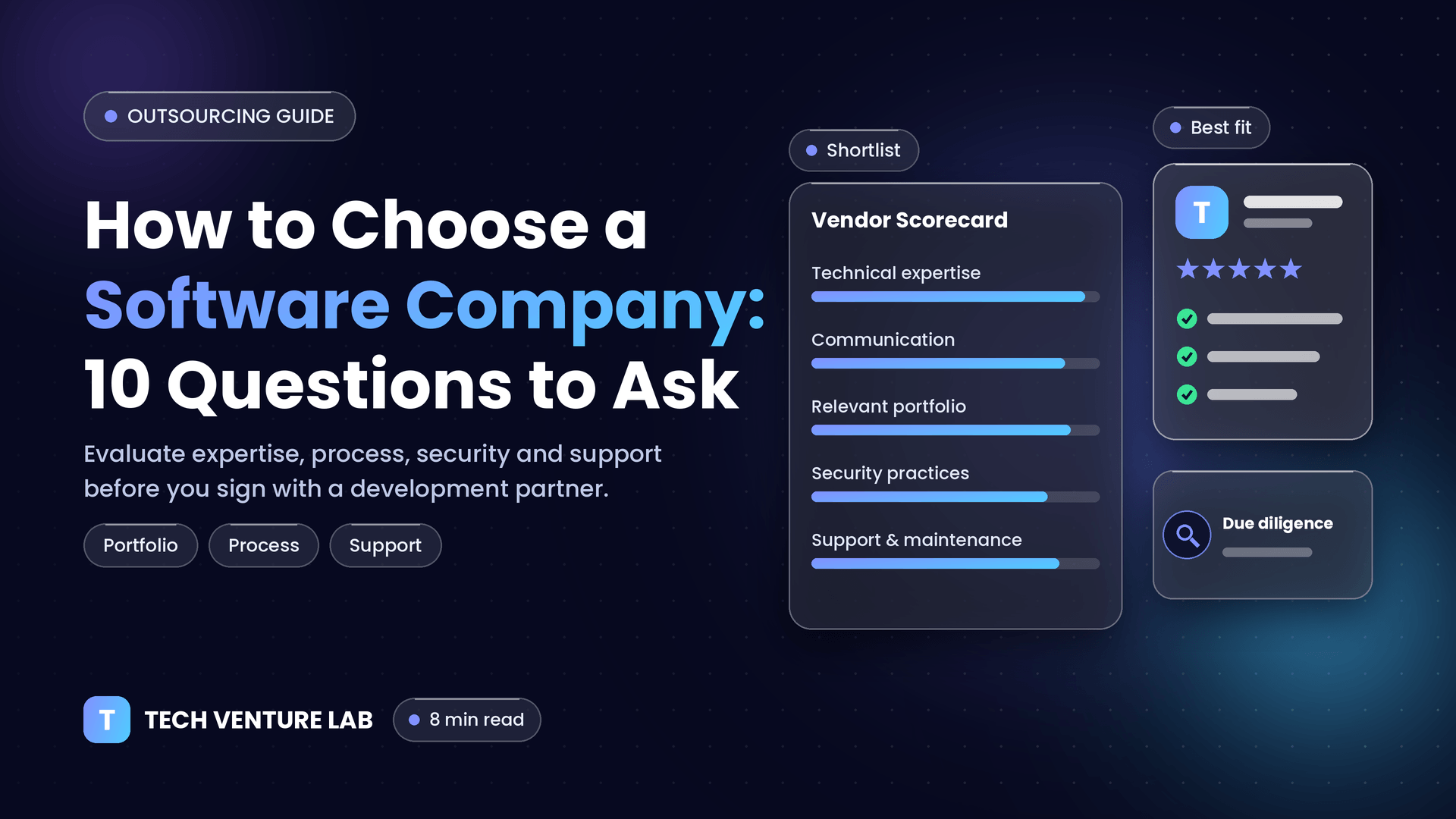
Create a simple scorecard and rate each company, for example from 1 to 5, on:
Also consider how they respond to your brief. Strong teams point out risks, suggest alternatives and clarify requirements, rather than simply copying your list into a quote.
If you are unsure, reduce risk with a paid discovery phase or pilot project. A short engagement for requirements, design or a small MVP lets you experience the team's quality, communication and working style before committing to a larger budget.
At Tech Venture Lab, we are a software and technology company focused on building modern digital products, including web and mobile applications, SaaS platforms, AI solutions and intelligent automation systems. We work transparently, communicate regularly and focus on turning your ideas into scalable, reliable and impactful digital solutions.
Evaluating development partners? Book a free consultation. We are happy to answer these 10 questions about our own approach.
The best software development company for you is not simply the cheapest or the biggest. It is the one that understands your goals, communicates openly, builds with quality and security, and supports you after launch. Ask these questions, trust the evidence rather than the sales pitch, and choose a partner you can grow with.