 Tech Venture Lab
Let's turn your idea into a product people rely on
Tell us about your project. We'll reply within one business day with a clear next step, scope, and timeline.
Tell us about your project. We'll reply within one business day with a clear next step, scope, and timeline.
9 min readTech Venture Lab
Generative AI has moved quickly from curiosity to business tool. Teams now use it to draft content, summarize documents, answer customer questions, write code and analyze information in plain language. Yet many organizations still ask the same questions: Where does it actually create value? How do we use it safely with our own data? And where do we begin?
This guide cuts through the noise with practical use cases, an explanation of how modern AI applications work, and a clear starting plan.
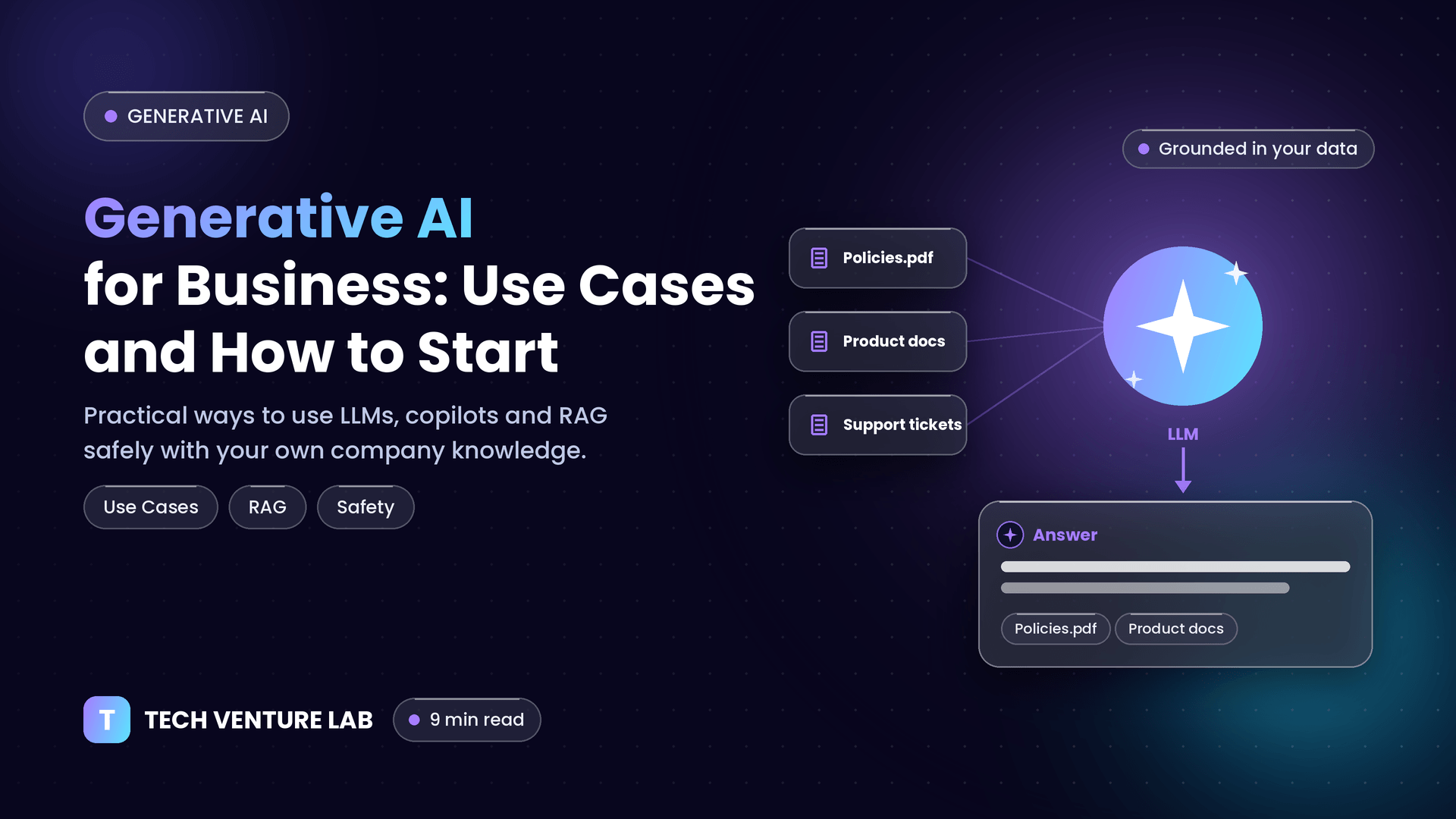
Generative AI refers to AI systems that create new content, such as text, images, code, audio or structured data, based on patterns learned from large amounts of training data. The most widely used business applications rely on large language models (LLMs), which understand and generate human language.
What makes LLMs useful for business is flexibility. A single model can summarize a contract, draft an email, classify a support ticket, explain a spreadsheet and answer a question, all through natural language instructions.
Public AI chat tools are useful for general tasks, but business use raises extra needs:
This is why many companies build custom AI applications on top of existing models.
One of the most important patterns is Retrieval-Augmented Generation (RAG). Instead of relying only on what the model learned during training, a RAG system gives it relevant company information at the moment a question is asked.
The process in simple steps:
Why it matters: RAG helps reduce made-up answers, keeps responses current without retraining the model and lets you control which information the AI can use.
Beyond answering questions, generative AI can power agents that take actions: looking up an order, creating a ticket, scheduling a meeting or updating a record, with appropriate permissions and human approval for sensitive steps. Start with assistants and low-risk actions, and expand as trust and controls mature.
Generative AI is powerful but imperfect. Responsible adoption means addressing these areas:
| Risk | What it means | How to reduce it |
|---|---|---|
| Inaccurate answers | Models can produce confident but wrong statements | Use RAG, show sources, test with real cases, keep humans in review |
| Data privacy | Sensitive data could be exposed or misused | Choose appropriate providers and settings, limit data shared, apply access controls |
| Security threats | Prompt manipulation and misuse of connected tools | Validate inputs and outputs, limit permissions, monitor activity |
| Bias and fairness | Outputs may reflect biases in data | Test across scenarios, set guidelines, review high-impact decisions |
| Intellectual property | Questions about generated content and training data | Review provider terms, apply human review and company policies |
| Over-reliance | Staff may trust outputs without checking | Train teams, define when verification is mandatory |
| Compliance | Regulations and industry rules may apply | Involve legal and compliance teams, keep audit logs |
A simple rule: the higher the impact of a decision, the more human oversight it needs.
Look for tasks that are text-heavy, repetitive and time-consuming, where a human can review the output, such as internal knowledge search, support drafting or document summarization.
Choose clear metrics: time saved, response speed, resolution rate, accuracy, user satisfaction or cost per task.
Good AI depends on good information. Check whether your documents are up to date, organized and accessible, and who owns them.
Use ready-made tools for general productivity needs. Consider custom solutions when you need integration with internal systems, strict security, domain-specific behaviour or a unique customer experience.
Start with one use case, a small group of users and real scenarios. Include guardrails, feedback buttons and logging from the start.
Evaluate with realistic and difficult questions, including edge cases and attempts to misuse the system. Measure accuracy and compare results with your baseline.
Explain what the tool can and cannot do, how to write good requests and when to verify results. Adoption depends on trust and skill.
Track usage, errors and feedback. Update knowledge sources, refine prompts and workflows, and expand to additional use cases gradually.
At Tech Venture Lab, we design and develop AI solutions and intelligent automation systems tailored to your business: knowledge assistants grounded in your own data, AI-powered workflows, custom copilots and integrations with your existing platforms. We emphasize security, reliability and measurable outcomes, so AI becomes a practical part of how your business works.
Want to explore what generative AI can do for your team? Talk to us and we will help you identify the best first use case.
Generative AI delivers the most value when it is applied to specific business problems, grounded in your own trusted information and governed with sensible safeguards. Start small, measure results, keep humans in the loop and expand step by step. That is how AI moves from an interesting demo to a dependable part of your business.