 Tech Venture Lab
Let's turn your idea into a product people rely on
Tell us about your project. We'll reply within one business day with a clear next step, scope, and timeline.
Tell us about your project. We'll reply within one business day with a clear next step, scope, and timeline.
9 min readTech Venture Lab
"Digital transformation" can sound like something only large corporations with big budgets attempt. In reality, small and mid-sized businesses (SMEs) are often the ones that benefit most. They are agile, decisions move quickly, and even modest improvements in efficiency or customer experience can have a large impact.
The challenge is knowing where to start. This roadmap breaks the journey into clear, manageable stages.
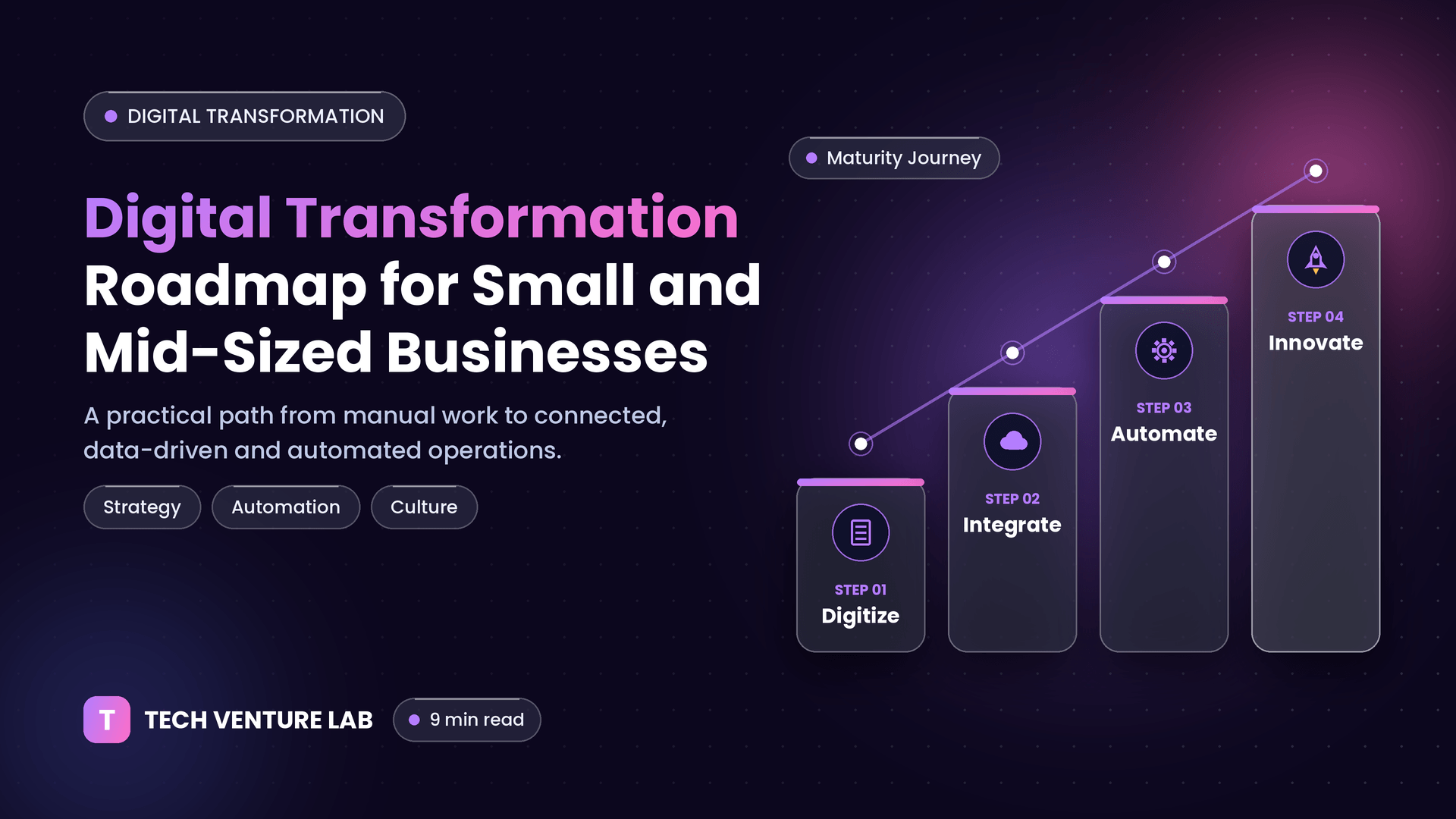
Digital transformation means using digital technology to change how your business operates and delivers value. It is not simply buying software. It covers:
Goal: Move from paper and scattered files to organized digital information.
Typical actions:
Digitization creates the foundation. You cannot analyze or automate what is not captured digitally.
Goal: Connect your systems so data flows instead of being re-typed.
Typical actions:
Integration ends the problem of different departments working from different numbers.
Goal: Let software handle repetitive work so people focus on higher-value tasks.
Typical actions:
Automation reduces errors, speeds up operations and lets you scale without proportionally increasing headcount.
Goal: Use your digital foundation to create new value.
Typical actions:
Innovation is much easier once the earlier stages are in place.
Start with outcomes, not technology. Examples: reduce order processing time, improve customer retention, enter a new market, cut operating costs. Make goals specific and measurable.
Map key processes, tools, data sources, pain points and skills. Ask employees and customers where the friction is. They often know exactly what needs fixing.
List possible initiatives and rank them. Focus first on high-impact, low-to-medium effort improvements, the quick wins that prove value and build momentum.
| Priority | Impact | Effort | Approach |
|---|---|---|---|
| Quick wins | High | Low | Do first |
| Strategic projects | High | High | Plan and phase |
| Fill-ins | Low | Low | Do when convenient |
| Time sinks | Low | High | Avoid or postpone |
Select tools that fit your needs, budget and team skills. Consider whether ready-made software is enough or whether a custom solution is justified for processes that give you a competitive edge. Prefer solutions that integrate well and can grow with you.
Test with one team or process. Measure results, gather feedback and refine before rolling out more widely.
Technology succeeds only when people use it. Communicate the "why", provide training, name internal champions and listen to concerns. Resistance usually comes from uncertainty, not stubbornness.
As more of your business becomes digital, security matters more. Use strong access controls, multi-factor authentication, backups and sensible data-handling policies, and be aware of regulations that apply to your customers and industry.
Track the metrics linked to your objectives, such as time saved, error rates, customer satisfaction, revenue per employee or cost per order. Review regularly and adjust the roadmap. Transformation is continuous, not a one-time project.
Use ready-made tools for standard needs such as accounting or email. Consider custom software when your process is unique, when you must integrate many systems, or when the solution will become part of your competitive advantage. Many successful SMEs combine both.
At Tech Venture Lab, we help growing businesses turn ideas into scalable, reliable digital solutions. From web and mobile applications to SaaS platforms, AI solutions and intelligent automation, we work with you to identify priorities, build the right systems and support continuous improvement.
Ready to plan your roadmap? Book a free consultation and we will help you identify your first high-impact step.
Digital transformation is not about chasing technology. It is about building a business that is faster, more connected and more responsive to customers. Digitize, integrate, automate and innovate, one prioritized step at a time, and measure the results as you go.