 Tech Venture Lab
Let's turn your idea into a product people rely on
Tell us about your project. We'll reply within one business day with a clear next step, scope, and timeline.
Tell us about your project. We'll reply within one business day with a clear next step, scope, and timeline.
8 min readTech Venture Lab
In many teams, releasing software still feels risky. Deployments happen late at night, someone copies files manually, and everyone hopes nothing breaks. Releases are infrequent because they are stressful, and they are stressful because they are infrequent.
DevOps and CI/CD break this cycle. They turn releases into a routine, automated, low-risk activity, which means features reach customers sooner and problems are caught earlier.
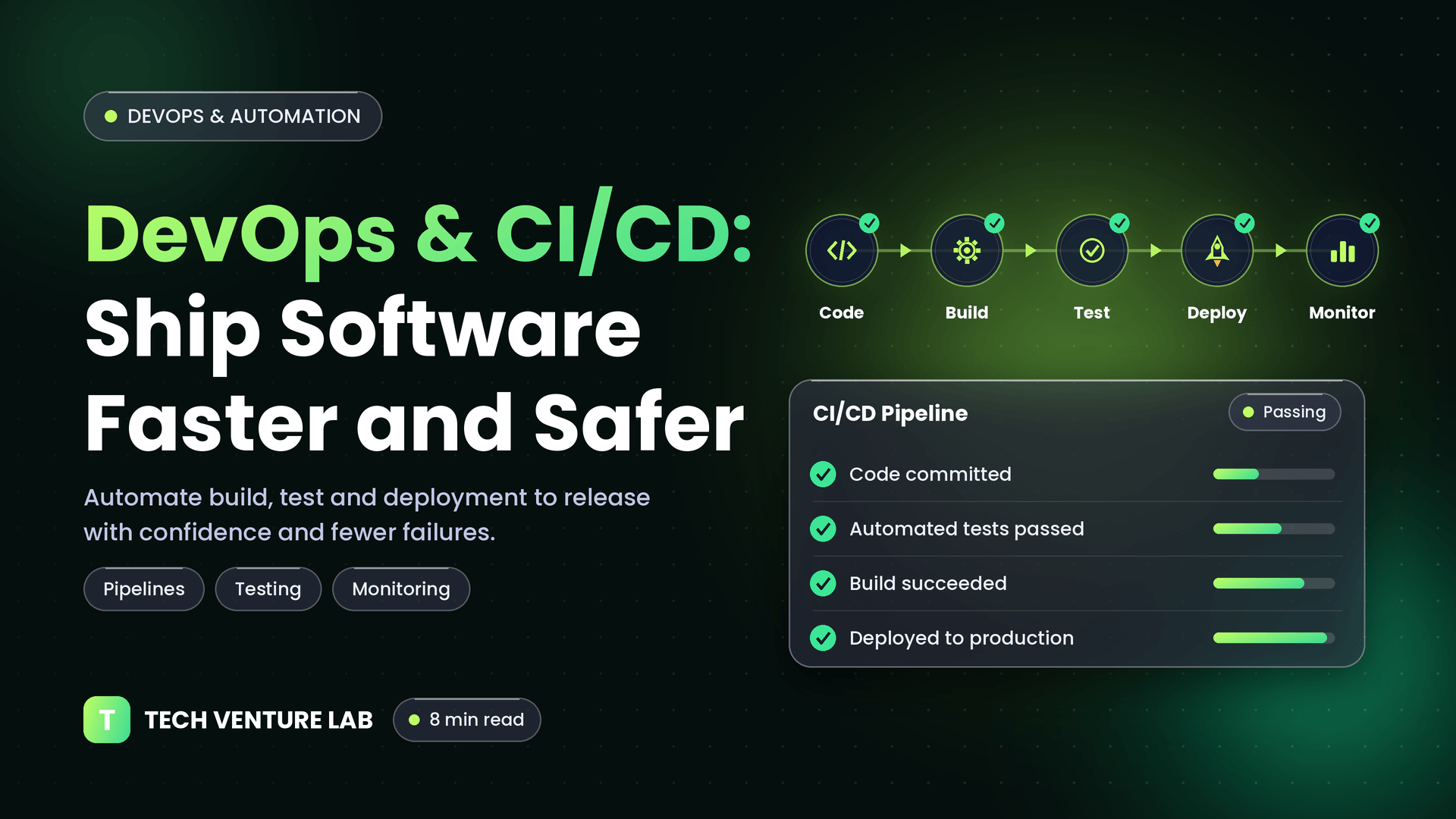
DevOps is a culture and set of practices that bring development (Dev) and operations (Ops) together. Instead of separate teams passing work "over the wall", people share responsibility for building, releasing and running software.
Core ideas include:
DevOps is not a tool or a job title. It is a way of working, supported by tools.
CI/CD is the automated pipeline that moves code from a developer's computer to production.
Continuous Integration (CI) Developers merge code changes into a shared repository frequently, often several times a day. Each change automatically triggers a build and a set of tests. Problems are discovered within minutes rather than weeks.
Continuous Delivery (CD) Every change that passes the automated checks is kept in a releasable state and can be deployed to production at any time, usually with a manual approval step.
Continuous Deployment The next level: every change that passes all checks is deployed to production automatically, with no manual approval.
A typical pipeline includes these stages:
Each stage acts as a quality gate. If something fails, the pipeline stops, and the team gets fast feedback.
Keep application code, configuration and infrastructure definitions in version control, so every change is traceable and reversible.
Build a balanced test suite: many fast unit tests, a smaller number of integration tests and a few critical end-to-end tests. Fast, reliable tests are the foundation of confident releases.
Define servers, networks and cloud resources in code using tools such as Terraform or cloud-native templates. Environments become reproducible, reviewable and consistent.
Containers package an application with its dependencies, so it runs the same way everywhere. Orchestration platforms such as Kubernetes help manage deployment, scaling and recovery for larger systems.
Reduce deployment risk with techniques such as:
Collect logs, metrics and traces, and set meaningful alerts. You should know about a problem before your customers report it.
Integrate security into the pipeline with dependency scanning, static and dynamic analysis, secret detection and container image checks. Fixing security issues early is far cheaper than after release.
The widely used DORA metrics help teams measure delivery performance:
Improving these metrics over time is a clear signal of progress.
Start with one project rather than the whole organization, then expand using what you learn.
At Tech Venture Lab, we build software with modern delivery practices from day one. We set up reliable CI/CD pipelines, cloud infrastructure, automated testing and monitoring, so your team can release with confidence and your product can evolve quickly without sacrificing stability.
Want faster, safer releases? Contact us to discuss your delivery pipeline.
DevOps and CI/CD make software delivery predictable. By automating builds, tests and deployments, integrating security, and monitoring what you ship, you can release more often, with higher quality and less stress. Start small, measure progress and keep improving.