 Tech Venture Lab
Let's turn your idea into a product people rely on
Tell us about your project. We'll reply within one business day with a clear next step, scope, and timeline.
Tell us about your project. We'll reply within one business day with a clear next step, scope, and timeline.
8 min readTech Venture Lab
Sooner or later, every growing business faces the same question: Should we buy ready-made software, or build something made for us? Both options can be the right answer. The wrong choice, however, can mean wasted budget, frustrated teams and processes that do not fit how you work.
This guide explains the real differences, the hidden costs on both sides, and a simple framework for making the decision.
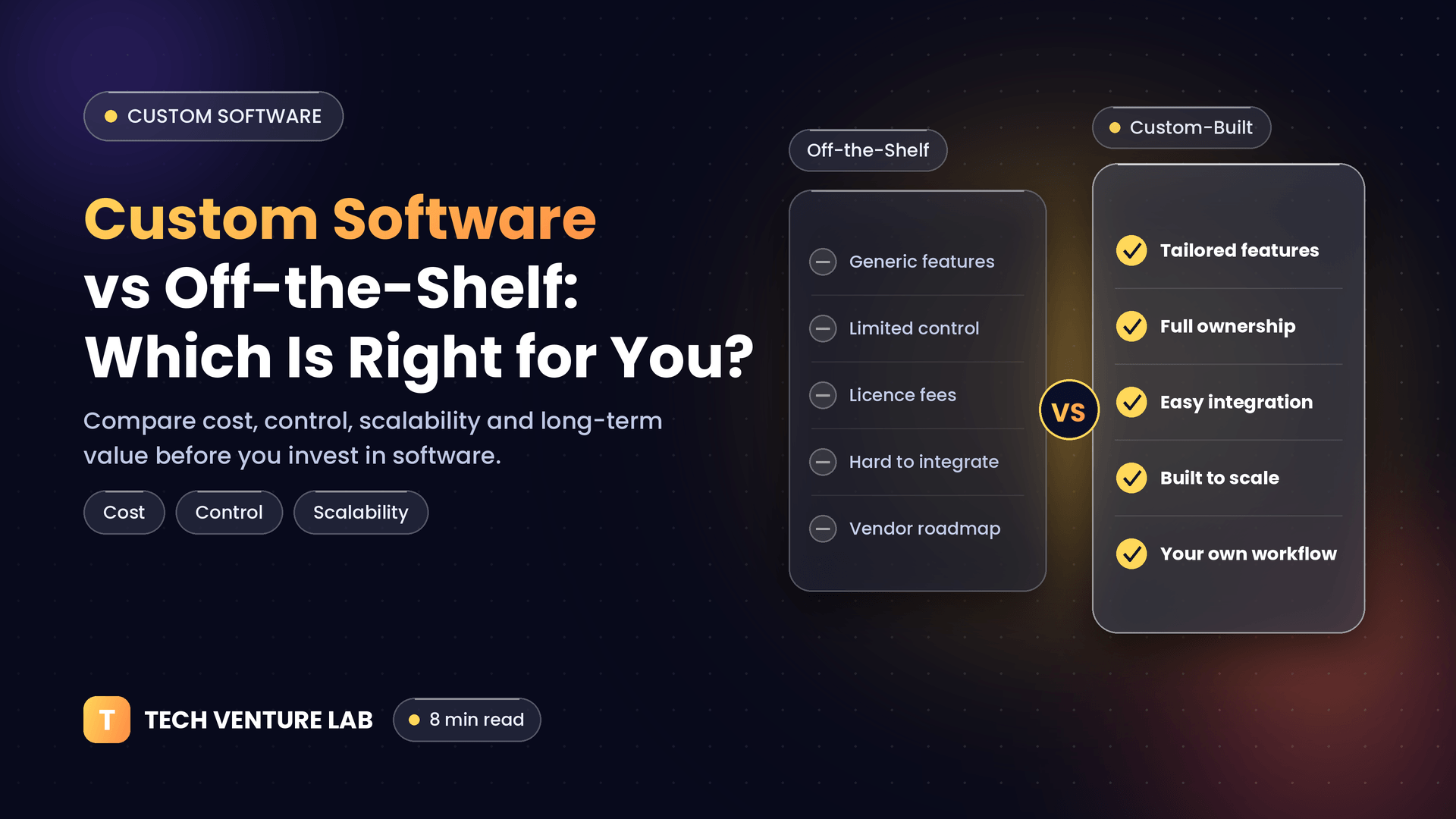
Off-the-shelf (or "packaged") software is built for a broad audience and sold or licensed to many customers. Examples include accounting tools, CRMs, project management apps and email platforms. You subscribe or buy a licence, configure the settings and start using it.
Custom software, also called bespoke software, is designed and built specifically for your business, your workflows and your users. You define the requirements, and a development team creates a solution that fits them. Common examples are internal operations platforms, customer portals, SaaS products, integration layers and automation systems.
| Factor | Off-the-Shelf | Custom Software |
|---|---|---|
| Upfront cost | Lower | Higher |
| Time to start | Immediate or very fast | Weeks to months |
| Fit with your process | Partial; you adapt to the tool | Exact; the tool adapts to you |
| Flexibility | Limited to available settings | Fully flexible |
| Scalability | Depends on the vendor's plans | Designed around your growth |
| Integrations | Only what the vendor supports | Any system with an API |
| Ownership | Licence; the vendor owns the product | You own the code and the data model |
| Ongoing fees | Recurring licence or per-user pricing | Maintenance and hosting costs |
| Competitive advantage | Same tools as everyone else | Can become a differentiator |
The cheapest option on day one is not always the cheapest over three to five years. When comparing, include:
You do not have to choose only one. Many businesses use off-the-shelf tools for standard functions such as email or payroll, and build custom software for the processes that set them apart. They then connect everything through APIs. This balances speed, cost and differentiation.
Ask yourself:
If most answers favour standard needs and speed, buy. If they favour uniqueness, integration and long-term control, build.
At Tech Venture Lab, we help businesses evaluate their options honestly, whether that means recommending an existing tool or building a tailored solution. When custom software is the right fit, we design and develop scalable, secure and reliable web, mobile and SaaS products around your goals.
Not sure which route to take? Book a free consultation and we will help you compare the options for your situation.
Neither option is universally better. Off-the-shelf software wins on speed and simplicity; custom software wins on fit, control and long-term differentiation. Evaluate the total cost, the strategic importance of the process, and your growth plans, and choose the path that supports where your business is going.