 Tech Venture Lab
Let's turn your idea into a product people rely on
Tell us about your project. We'll reply within one business day with a clear next step, scope, and timeline.
Tell us about your project. We'll reply within one business day with a clear next step, scope, and timeline.
9 min readTech Venture Lab
Software as a Service (SaaS) has become one of the most popular ways to deliver software. Instead of buying and installing a program, customers subscribe and use it online. For founders and businesses, SaaS offers recurring revenue, global reach and continuous improvement, but only when the product is built on the right foundation.
This guide covers the essentials of SaaS development, from planning and architecture to security and growth.
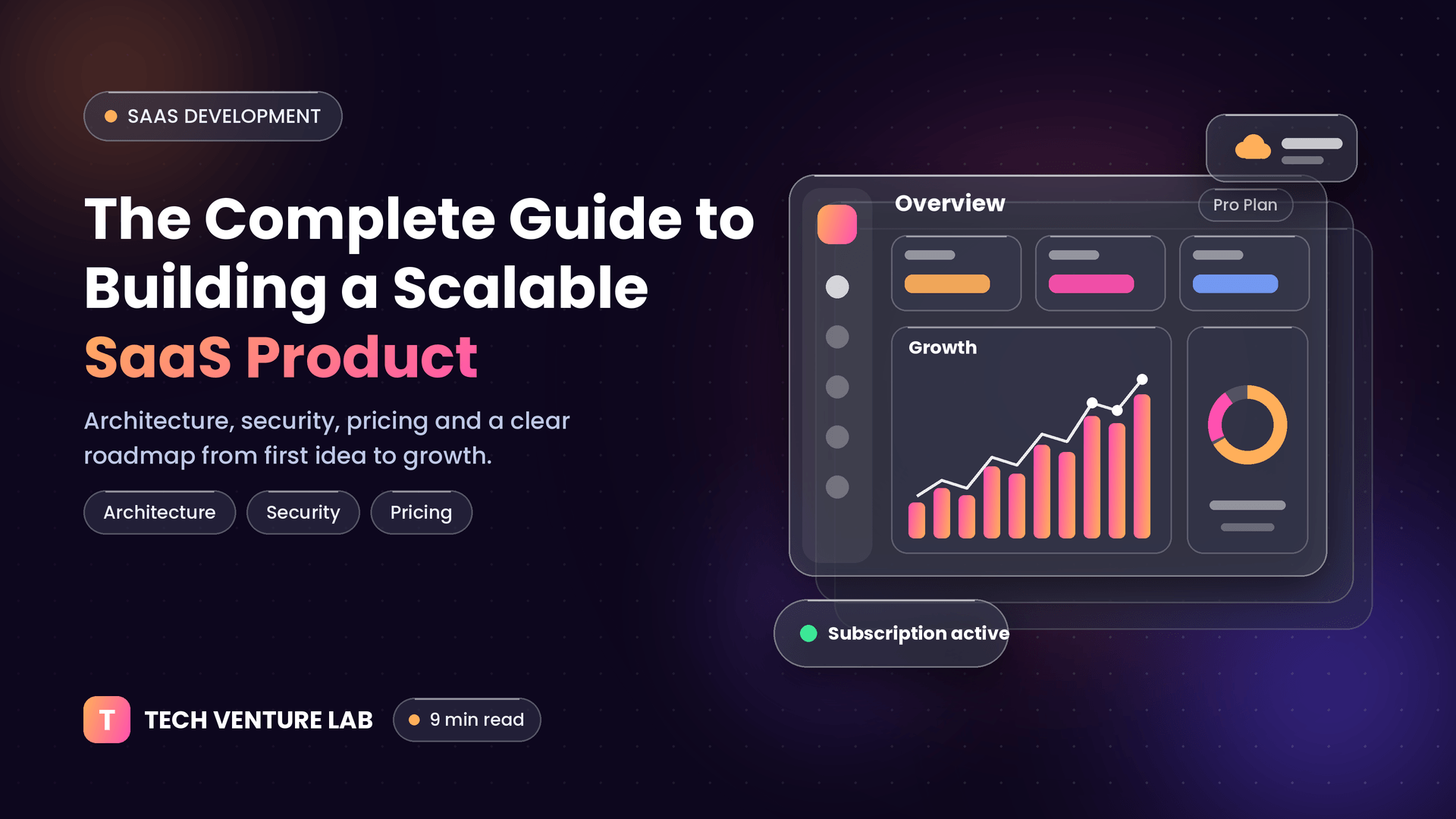
SaaS is a delivery model where software is hosted in the cloud and accessed through a browser or app, usually on a subscription basis. Familiar examples include project management tools, CRMs, accounting platforms and communication software.
Key characteristics of a SaaS product:
Before writing code, confirm that a real, painful problem exists. Interview potential users, study competitors and define who exactly you are building for. Many SaaS products fail not because of bad technology, but because nobody needed them.
A Minimum Viable Product includes only the core features needed to solve the main problem. Resist the temptation to add everything. A focused MVP reaches the market sooner and generates real feedback.
SaaS users judge a product in minutes. Invest in clear onboarding, intuitive navigation and a clean interface. Good UX reduces churn and support costs.
Architecture decisions made early are expensive to change later. Key considerations include:
There is no single best stack. Choose technologies your team can maintain and that match your requirements. A typical modern stack might include a JavaScript/TypeScript front end, a robust backend framework, a relational database such as PostgreSQL, caching, background job processing and containerized deployment.
Most SaaS platforms need these building blocks:
| Feature | Why it matters |
|---|---|
| Authentication and roles | Secure access with proper permissions |
| Subscription billing | Plans, trials, invoices and upgrades |
| Admin dashboard | Manage users, plans and support |
| Notifications | Email and in-app alerts for engagement |
| Analytics | Track usage, retention and conversion |
| Integrations and API | Connect with other tools customers use |
Customers trust you with their data, so protect it. Fundamentals include encryption in transit and at rest, strong authentication (including multi-factor options), role-based access control, regular backups, audit logs and secure development practices. Depending on your market, you may also need to consider regulations such as GDPR.
Combine automated testing with real-user beta feedback. After launch, use monitoring and logging to detect issues early, and track uptime, performance and error rates.
Launch is the start. Use customer feedback and analytics to refine features, improve onboarding and expand into new segments.
Choose a model that aligns price with the value customers receive.
Building a SaaS product involves product strategy, UX, cloud architecture, security and ongoing maintenance. An experienced partner helps you avoid costly early mistakes and move from idea to launch with confidence.
At Tech Venture Lab, we build SaaS platforms that are modern, scalable and reliable, from MVP to enterprise-ready systems. We combine solid engineering with a business-first mindset to turn your idea into a product customers love.
Have a SaaS idea? Contact us to discuss your roadmap.
A successful SaaS product combines a real market need, a focused MVP, a scalable architecture and a commitment to continuous improvement. Get the foundations right, and growth becomes far easier to sustain.