 Tech Venture Lab
Let's turn your idea into a product people rely on
Tell us about your project. We'll reply within one business day with a clear next step, scope, and timeline.
Tell us about your project. We'll reply within one business day with a clear next step, scope, and timeline.
9 min readTech Venture Lab
Moving to the cloud is no longer just an IT project. It affects how fast you can launch products, how well you handle growth, how you manage costs and how resilient your business is when something goes wrong. But a poorly planned migration can bring downtime, surprise bills and security gaps.
This guide walks through what cloud migration really involves and how to plan one that delivers value.
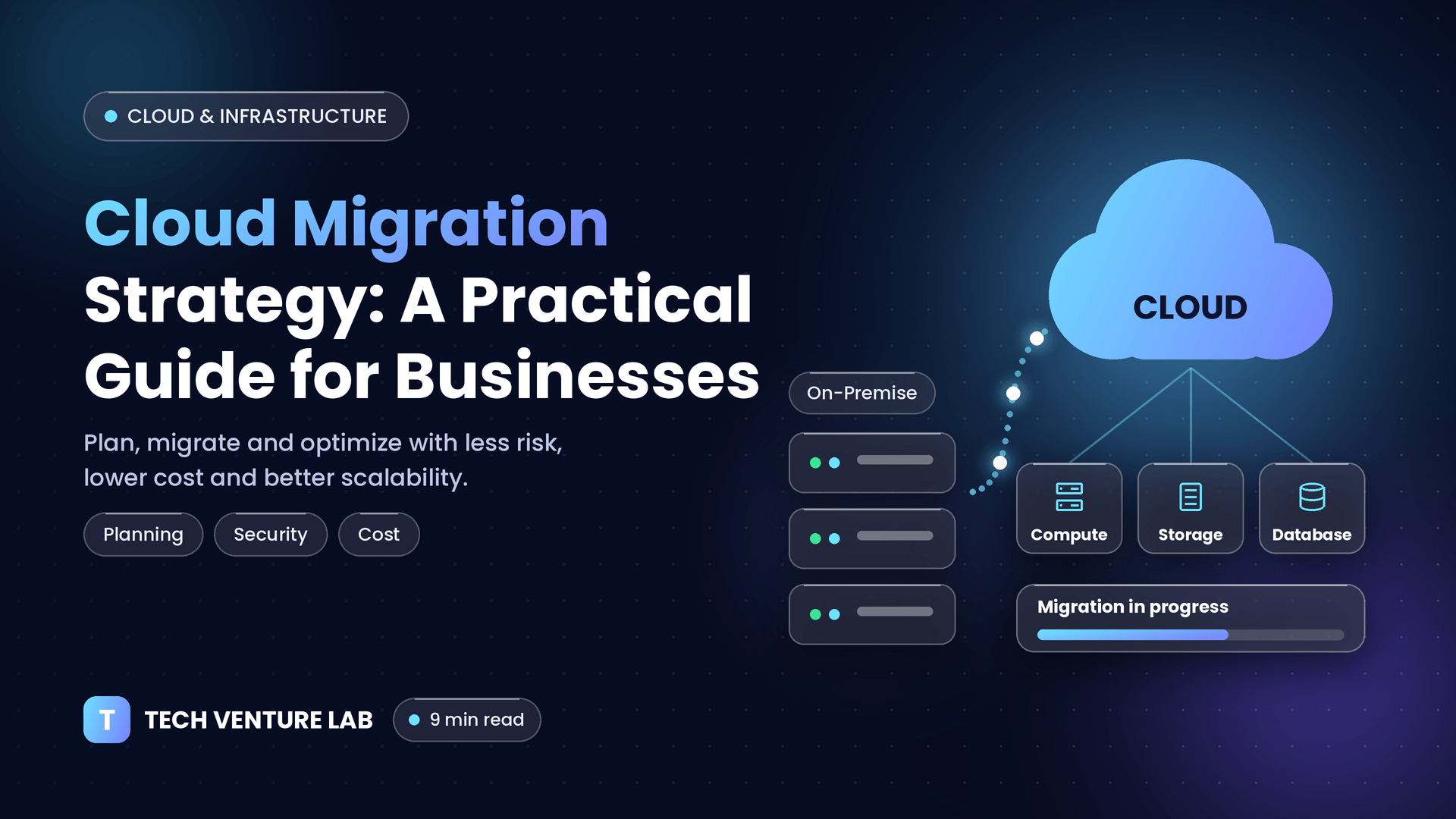
Cloud migration is the process of moving applications, data and workloads from on-premise servers (or another environment) to cloud infrastructure provided by platforms such as AWS, Microsoft Azure or Google Cloud. It can also mean moving between clouds or modernizing applications so they take better advantage of cloud capabilities.
Not every application should be migrated the same way. The commonly used 6 Rs framework helps you choose:
| Strategy | What it means | Best for |
|---|---|---|
| Rehost (lift and shift) | Move as-is to cloud servers | Fast migrations, tight deadlines |
| Replatform (lift, tinker and shift) | Make small optimizations, such as moving to a managed database | Quick wins with moderate effort |
| Refactor / Re-architect | Redesign the application to be cloud-native | Apps that need major scalability and agility |
| Repurchase | Replace with a SaaS product | Commodity software such as email or CRM |
| Retire | Decommission what is no longer needed | Unused or duplicate systems |
| Retain | Keep on-premise for now | Compliance, latency or recent investment reasons |
A good migration plan usually uses a mix of these approaches across different systems.
Be clear about why you are moving: reduce infrastructure cost, improve reliability, support growth, launch a new product, or exit a data center contract. Goals shape every decision that follows.
Create an inventory of applications, databases, dependencies, data volumes, performance needs and owners. Identify which systems are critical, which are outdated and which have tight interdependencies. Skipping this step is one of the most common causes of migration trouble.
Apply the 6 Rs to each application. Consider technical complexity, business value, risk, compliance and the effort required.
Compare providers based on required services, regional availability, pricing, compliance certifications and your team's skills. Decide whether a single cloud, multi-cloud or hybrid model fits your needs. Avoid complexity unless you have a clear reason for it.
Define identity and access management, network segmentation, encryption, logging, backup policies and compliance controls before moving data. Understand the shared responsibility model: the provider secures the underlying infrastructure, while you remain responsible for configuring and protecting your data, access and applications.
Estimate costs using provider calculators, but plan for real usage patterns. Tag resources by team and project, set budgets and alerts, and review spending regularly. This discipline, often called FinOps, prevents "bill shock".
Migrate a low-risk, non-critical workload first. Use it to validate your process, tooling, security setup and team readiness.
Move workloads in planned waves. For each one, prepare a rollback plan, test thoroughly, schedule cutovers during low-traffic windows and communicate clearly with stakeholders.
Verify functionality, performance, data integrity, security controls and backup recovery. Compare results with baseline performance from the old environment.
After migration, the real benefits come from tuning: right-sizing resources, using auto-scaling, adopting managed services, automating deployments and improving observability. Cloud migration is a beginning, not an end.
Data and downtime. Plan how large datasets will be transferred and how much downtime the business can tolerate. Techniques such as incremental replication can reduce cutover windows.
Compliance and data residency. Some industries and regions have rules about where data may be stored and processed. Check requirements early.
Skills and change management. Your team needs training in cloud operations, security and cost management. Involve stakeholders early so adoption is smooth.
Vendor lock-in. Some lock-in is natural when using managed services, and often worth the benefits. Make the trade-off consciously, and keep data portable where it matters.
Track metrics tied to your goals: infrastructure cost per workload, deployment frequency, uptime and recovery time, application performance, security incidents and team productivity. Review them regularly and adjust.
At Tech Venture Lab, we help businesses design and execute cloud strategies that are secure, cost-aware and built to scale. Whether you need to migrate an existing system, modernize an application or build a new cloud-native product, our team supports you from assessment to optimization.
Thinking about moving to the cloud? Talk to our team and we will help you plan the safest, most practical path.
A successful cloud migration is built on clear goals, honest assessment, the right strategy for each workload, strong security and ongoing optimization. Start small, learn quickly and scale with confidence, and the cloud becomes a foundation for growth rather than just a new place to host servers.