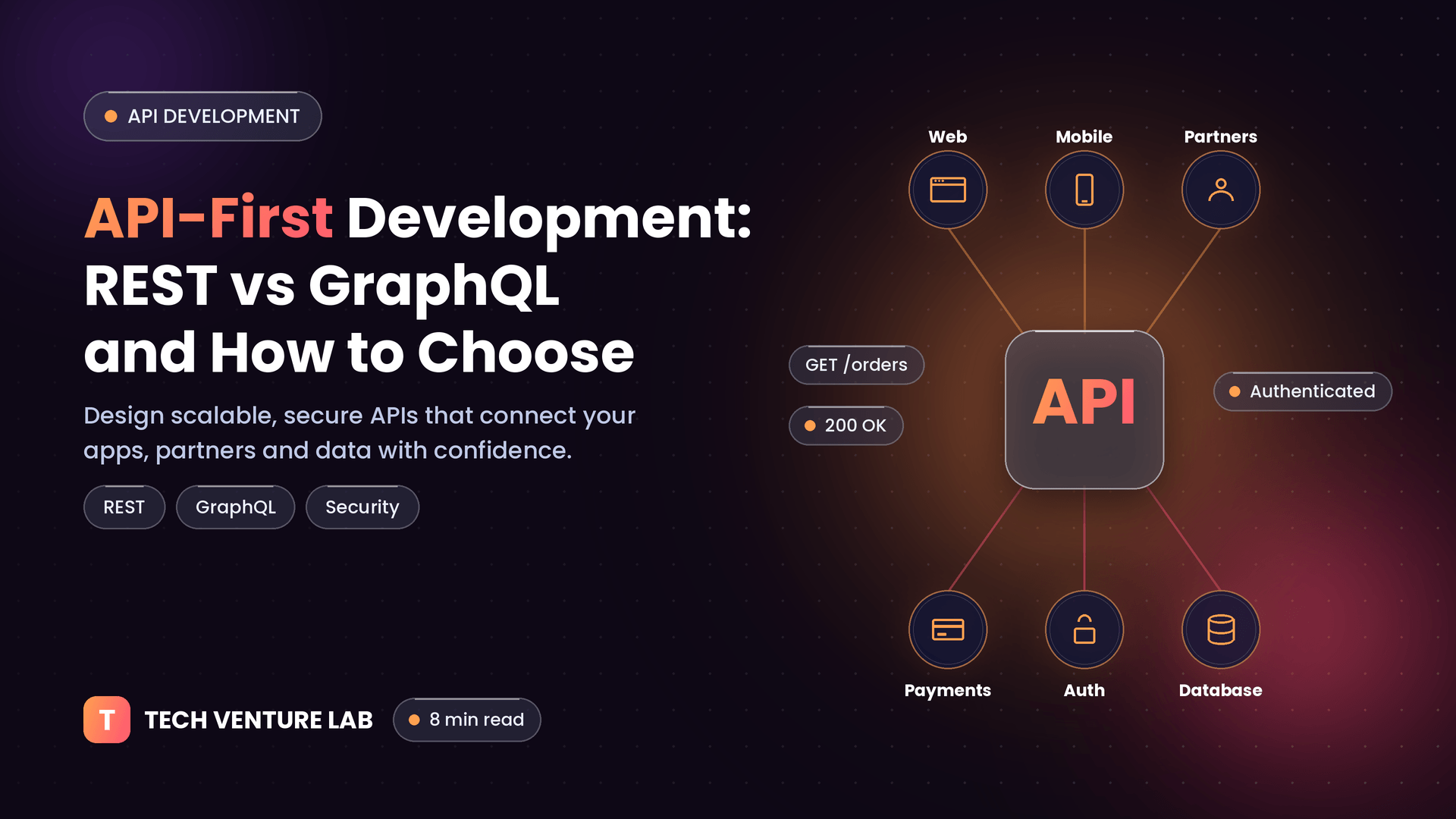
API-First Development: REST vs GraphQL and How to Choose
·8 min read·Tech Venture Lab
Behind almost every modern digital product, there is an API. When a mobile app shows your orders, a website processes a payment or a partner system receives your data, an Application Programming Interface is doing the work in the background.
As products grow across web, mobile and third-party integrations, how you design your APIs becomes a major factor in speed, scalability and long-term maintainability. This guide explains API-first development and helps you choose between REST and GraphQL.
What Is an API?
An API is a defined way for software systems to communicate. One system sends a request, and another returns a response in an agreed format, usually JSON. APIs let you separate the user interface from business logic and data, so many different clients can use the same backend.
What Does "API-First" Mean?
In an API-first approach, the API is designed before the applications that use it, and is treated as a core product rather than an afterthought. Teams agree on the API contract early, often documenting it with a specification such as OpenAPI, and then build the backend and clients in parallel against that contract.
Benefits of API-first development
Parallel development: Front-end, mobile and backend teams can work at the same time using mock APIs.
Consistency: One well-designed API serves web, mobile, partners and future platforms.
Faster integrations: Clear documentation lets partners and customers connect easily.
Scalability and flexibility: Services can evolve independently behind a stable contract.
Better quality: Reviewing the design early catches problems before code is written.
New business opportunities: Well-designed APIs can become products or partner channels.
REST: The Established Standard
REST (Representational State Transfer) is an architectural style that organizes APIs around resources, such as customers, orders and products, each accessed through a URL and standard HTTP methods.
Example:
`GET /orders/1042` retrieves an order
`POST /orders` creates an order
`PUT /orders/1042` updates it
`DELETE /orders/1042` removes it
Strengths of REST
Simple, widely understood and supported by almost every tool and language
Works well with HTTP caching, which improves performance
Easy to document, test and monitor
Large ecosystem and talent pool
Excellent for standard, resource-oriented operations
Limitations of REST
Over-fetching: an endpoint may return more data than the client needs
Under-fetching: a screen may require several requests to different endpoints
Versioning and many endpoints can become harder to manage as the product grows
GraphQL: Flexible Data Fetching
GraphQL is a query language and runtime for APIs. Instead of many endpoints, clients typically use a single endpoint and describe exactly the data they need. The server returns precisely that structure.
For example, a mobile screen can request only a customer's name and their last three orders in one request, rather than calling several endpoints and discarding unused fields.
Strengths of GraphQL
Exact data fetching reduces over-fetching and the number of network calls
Strongly typed schema that serves as living documentation
Great for complex, interconnected data and multiple client types with different needs
Faster front-end iteration: UI teams can change the data they request without waiting for new endpoints
Limitations of GraphQL
More complex to set up, secure and optimize
HTTP caching is less straightforward than with REST
Poorly designed queries can put heavy load on servers, so depth limits and query-cost controls are needed
Steeper learning curve for teams new to it
REST vs GraphQL: Side-by-Side
Factor
REST
GraphQL
Structure
Multiple endpoints by resource
Typically a single endpoint with a schema
Data fetching
Fixed responses per endpoint
Client specifies exact fields
Over/under-fetching
Common
Largely avoided
Caching
Simple, uses HTTP caching
More complex, needs additional tooling
Learning curve
Low
Moderate
Tooling and maturity
Very mature, universal
Mature and growing
Best for
Simple to moderate APIs, public APIs, microservices
You are building a straightforward, resource-based API
You want maximum simplicity, tooling support and easy caching
You are exposing a public API to many third parties
Your team is new to API design
Choose GraphQL when:
You have multiple clients (web, mobile, partners) needing different data shapes
Your data model is rich and highly connected
You want to reduce network requests, especially on mobile
Your front-end team iterates quickly and needs flexibility
Use both when it makes sense. Many organizations expose REST for public integrations and use GraphQL as a flexible layer for their own applications. It is not an either-or decision.
API Design Best Practices
Design the contract first. Document endpoints, schemas, errors and examples before building.
Use clear, consistent naming. Use nouns for resources and predictable patterns.
Return meaningful status codes and error messages that help developers fix problems.
Plan versioning from the start so you can evolve without breaking existing clients.
Support pagination, filtering and sorting for large collections.
Make operations idempotent where appropriate, so retries do not cause duplicates.
Write excellent documentation with examples; developer experience matters.
Provide a sandbox or test environment for integrators.
API Security Essentials
APIs are a prime target for attackers, so security cannot be optional:
Authentication and authorization: use standards such as OAuth 2.0 and OpenID Connect, with token-based access and least-privilege scopes.
Encryption: serve all traffic over HTTPS.
Input validation: validate every request against the schema.
Rate limiting and throttling: protect against abuse and overload.
Limit data exposure: return only what the client is authorized to see.
Logging and monitoring: detect suspicious patterns early.
For GraphQL specifically: apply query depth and complexity limits and be careful with schema introspection in production.
Performance and Scalability Tips
Use caching at the right layers
Apply pagination to large results
Use asynchronous processing or webhooks for long-running tasks
Monitor latency and error rates continuously
Design for horizontal scaling behind a load balancer or API gateway
Common API Mistakes
Building the UI first and bolting an API on later
Inconsistent naming and response formats across endpoints
Breaking changes with no versioning or communication
Poor or outdated documentation
Ignoring security and rate limiting until after launch
Choosing GraphQL or REST based on trends rather than needs
Build Robust APIs With Tech Venture Lab
At Tech Venture Lab, we design and build secure, well-documented APIs that power web apps, mobile apps and SaaS platforms. Whether you need a new API-first architecture, integrations with third-party systems or a modernization of existing services, we help you create a backend that is ready to grow.
Planning an API or integration project?Get in touch to discuss your architecture.
Frequently Asked Questions
Conclusion
An API-first mindset makes your products more consistent, scalable and ready for integration. Choose REST for simplicity and broad compatibility, GraphQL for flexible data access, or combine them, and always invest in clear design, strong security and good documentation.
 Tech Venture Lab