 Tech Venture Lab
Let's turn your idea into a product people rely on
Tell us about your project. We'll reply within one business day with a clear next step, scope, and timeline.
Tell us about your project. We'll reply within one business day with a clear next step, scope, and timeline.
8 min readTech Venture Lab
"We need an AI chatbot" is one of the most common requests businesses make today. But the market has moved on. Alongside chatbots, AI agents have emerged: systems that can not only talk, but also plan, use tools and complete tasks.
The terms are often mixed up, and choosing the wrong one leads to disappointing results or unnecessary cost. This guide explains the difference clearly and helps you decide what fits your business.
A chatbot is software that converses with users through text or voice. There are two broad kinds:
A chatbot's main job is answering questions and guiding conversations.
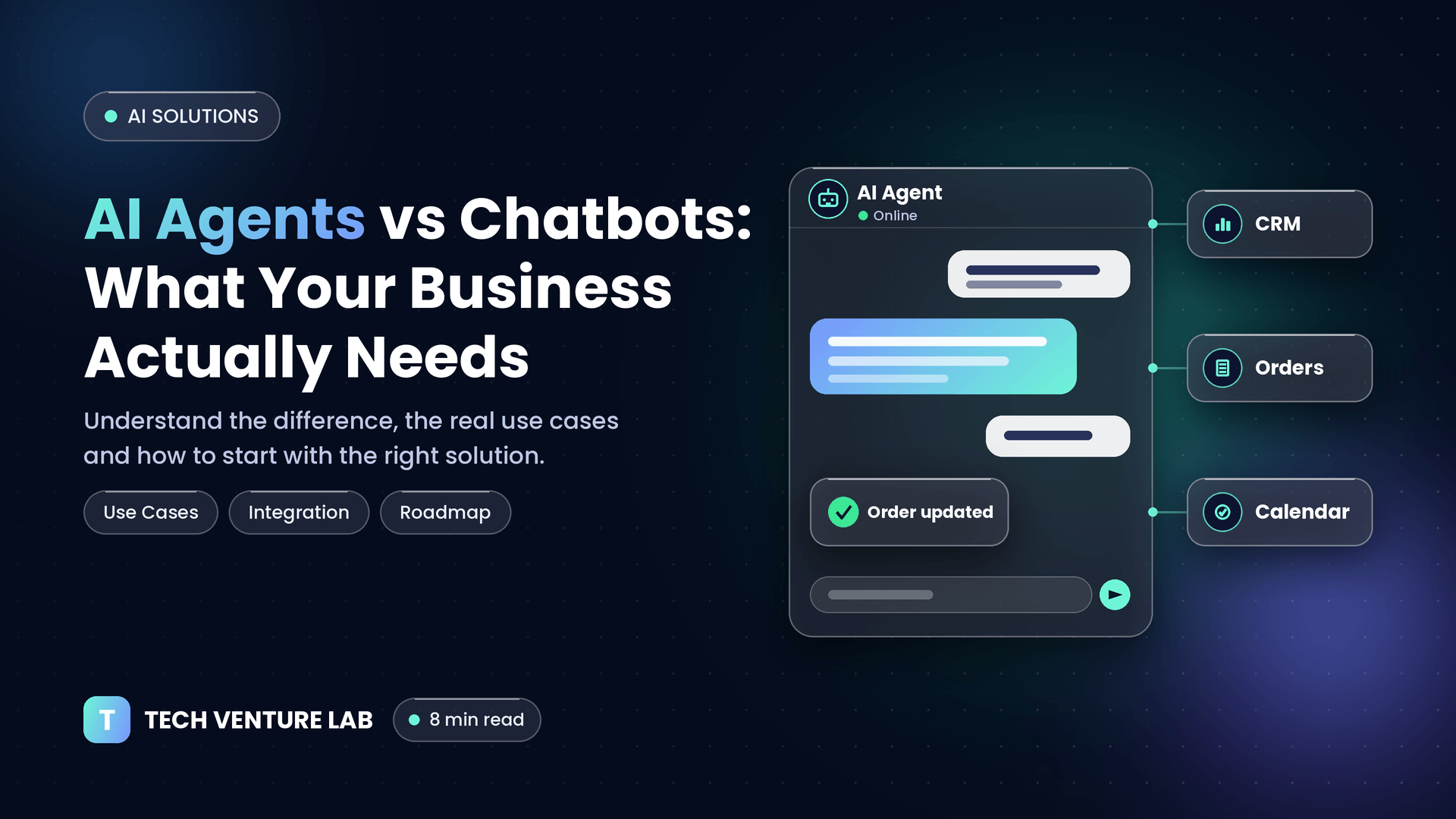
An AI agent is a system built on a language model that can pursue a goal. Rather than only generating replies, it can break a request into steps, decide what to do next, call tools such as databases, CRMs, calendars or internal APIs, check the results and continue until the task is done, often with human approval at key points.
An agent's main job is getting work done, not just talking about it.
| Aspect | Chatbot | AI Agent |
|---|---|---|
| Primary purpose | Answer questions and guide users | Complete tasks and workflows |
| Interaction | Mostly reactive, conversation-based | Goal-driven, multi-step |
| Tool and system access | Limited or none | Connects to business systems and APIs |
| Decision-making | Follows scripts or generates replies | Plans, chooses actions and adapts |
| Typical output | Information | Outcomes (a booking made, a ticket resolved, a record updated) |
| Complexity and risk | Lower | Higher; needs careful controls |
| Implementation effort | Faster and simpler | More design, integration and testing |
A customer writes: "I want to change my delivery address for order 1042."
Both are useful. The agent simply goes one step further, from information to action.
Ask these questions:
Often the best answer is layered: a chatbot for common questions, an agent for defined workflows, and a human for complex or sensitive cases.
AI systems are powerful but not perfect. Responsible deployment includes:
Ready-made platforms are a good way to start with simple needs. Custom solutions make sense when you need deep integration with internal systems, strict security, specialized workflows or a unique customer experience. Many businesses begin with a pilot and move to a tailored solution as requirements grow.
At Tech Venture Lab, we design and develop AI solutions and intelligent automation systems, from smart chatbots to agent-based workflows integrated with your existing tools. We focus on practical outcomes, security and reliability, so AI becomes a dependable part of your business operations.
Curious what AI could do for your team? Talk to us and we will help you identify the best first use case.
Chatbots help customers find answers; AI agents help businesses get work done. Start with the problem you want to solve, choose the simplest solution that solves it well, add safeguards, and grow from there. That approach delivers real value without unnecessary complexity.