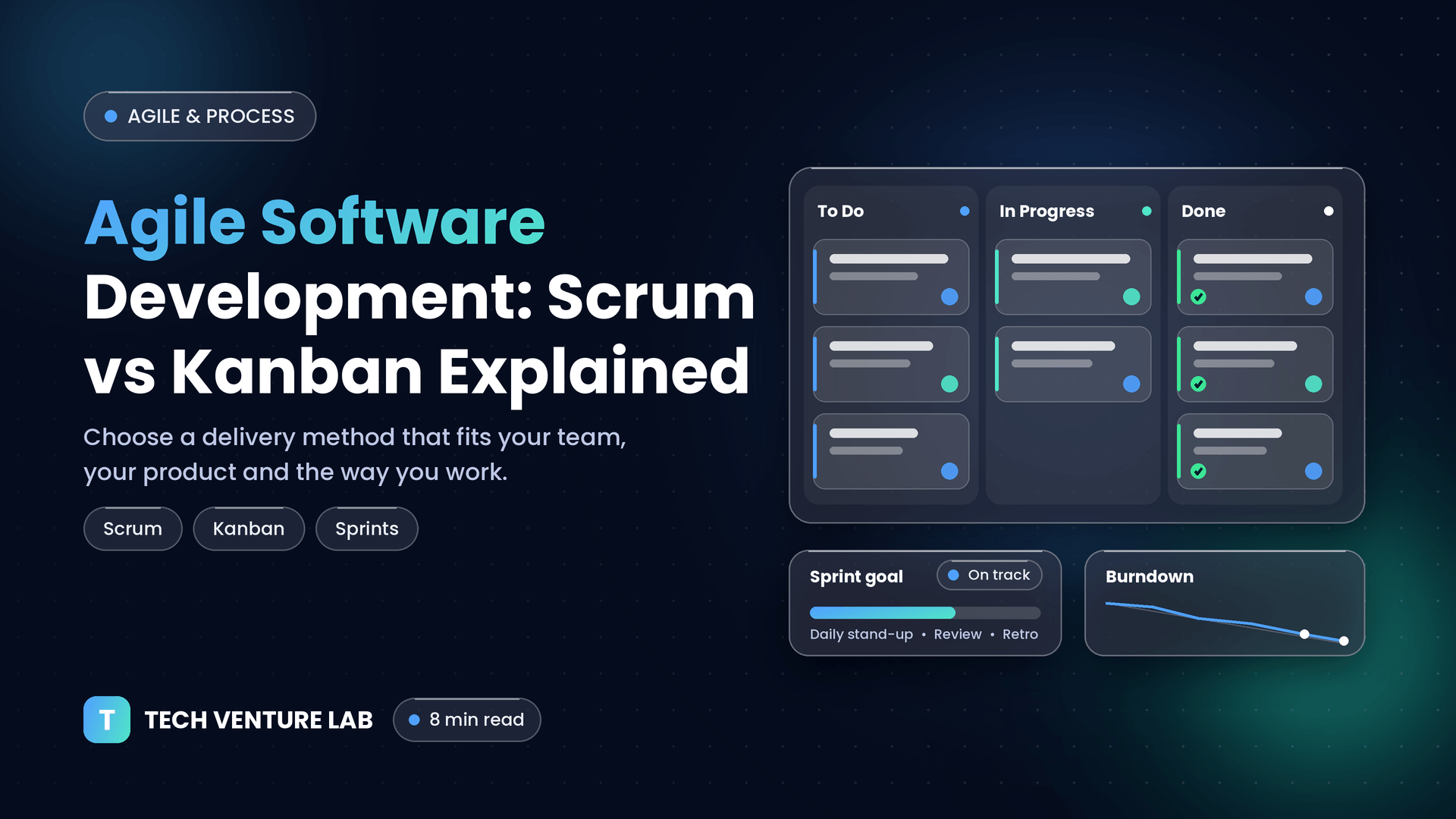
Agile Software Development: Scrum vs Kanban Explained
·8 min read·Tech Venture Lab
Software projects rarely go exactly as planned. Requirements change, users react in unexpected ways and markets move. Traditional approaches that define everything upfront and deliver at the end often produce software that is late, over budget or no longer what the business needs.
Agile was created to address this reality. This guide explains what Agile is, how the two most popular frameworks, Scrum and Kanban, work and how to choose between them.
What Is Agile?
Agile is a mindset and set of principles for developing software in small, iterative steps, delivering working results frequently and adapting based on feedback. It was formalized in the Agile Manifesto, which values:
Individuals and interactions over processes and tools
Working software over comprehensive documentation
Customer collaboration over contract negotiation
Responding to change over following a plan
The manifesto does not say the items on the right have no value; it says the items on the left matter more.
Agile vs Waterfall
Aspect
Waterfall
Agile
Planning
Detailed upfront
Continuous and adaptive
Delivery
One large release at the end
Small, frequent increments
Change
Difficult and costly
Expected and welcomed
Customer involvement
Mostly at start and end
Throughout
Risk
Discovered late
Reduced through early feedback
Best for
Fixed, well-understood scope and strict regulation
Evolving products, uncertainty, fast learning
Waterfall can still make sense for projects with fixed, well-known requirements. For most digital products, where learning is part of the work, Agile is a better fit.
Scrum Explained
Scrum is a structured framework that organizes work into fixed-length iterations called sprints, usually one to four weeks long. At the end of each sprint, the team delivers a potentially releasable increment of the product.
Scrum roles
Product Owner: represents the customer and business, owns the product backlog and decides priorities.
Scrum Master: helps the team follow Scrum, removes obstacles and improves the process. This is a servant-leader role, not a traditional manager.
Development Team: the cross-functional people (developers, designers, testers) who build the product and decide how to do the work.
Scrum artifacts
Product backlog: a prioritized list of everything that might be needed in the product.
Sprint backlog: the items selected for the current sprint, with a plan to deliver them.
Increment: the usable, working result of the sprint.
Scrum events
Sprint planning: the team decides what can be delivered in the sprint and how.
Daily Scrum (stand-up): a short daily check-in, often 15 minutes, to align and surface blockers.
Sprint review: the team demonstrates the increment to stakeholders and gathers feedback.
Sprint retrospective: the team reflects on how it worked and decides what to improve.
Strengths of Scrum
Clear rhythm, roles and accountability
Regular delivery and stakeholder feedback
Good for building new products and features with a stable team
Encourages continuous improvement through retrospectives
Challenges of Scrum
Can feel heavy for teams with constantly shifting, unpredictable work
Requires discipline with roles and ceremonies
Mid-sprint changes are discouraged, which can be hard in fast-moving support environments
Kanban Explained
Kanban is a flow-based method that visualizes work on a board and focuses on limiting work in progress so tasks move smoothly from start to finish. There are no required sprints, roles or fixed iterations.
Core Kanban practices
Visualize the workflow. A board with columns such as To Do, In Progress, Review, Done shows where each task is.
Limit work in progress (WIP). Setting a maximum number of items per stage prevents overload and exposes bottlenecks.
Manage flow. Track how work moves and aim for smooth, predictable delivery.
Make policies explicit. Define clearly what "done" means and how work moves between stages.
Improve continuously. Use data and team feedback to refine the system.
Key Kanban metrics
Lead time: how long a task takes from request to completion
Cycle time: how long active work takes once started
Throughput: how many items are completed in a period
WIP: how many items are in progress at once
Strengths of Kanban
Highly flexible; new work can be added whenever capacity allows
Easy to adopt, since you start with your current process
Excellent for support, maintenance and operations work
Highlights bottlenecks clearly
Challenges of Kanban
Less built-in structure, so teams may lack planning rhythm and commitment unless they add routines
Without discipline on WIP limits, the board becomes a long to-do list
Fewer natural moments for demonstration and reflection unless the team schedules them
Scrum vs Kanban: Side-by-Side
Aspect
Scrum
Kanban
Cadence
Fixed-length sprints
Continuous flow
Roles
Product Owner, Scrum Master, Team
No required roles
Planning
At the start of each sprint
Ongoing, as capacity frees up
Changes mid-iteration
Generally avoided
Allowed at any time
Commitments
Sprint goal and scope
Limits on work in progress
Key metrics
Velocity, burndown
Lead time, cycle time, throughput
Release
At the end of sprints (or more often)
Whenever work is ready
Best for
Product development with planned increments
Continuous, unpredictable or support-oriented work
Which One Should You Choose?
Choose Scrum when:
You are building a new product or major features
You want regular planning, demos and feedback cycles
Your team is relatively stable and can commit to sprint goals
Stakeholders benefit from a predictable rhythm
Choose Kanban when:
Work arrives unpredictably, such as bug fixes, support requests and operations
You need maximum flexibility to reprioritize
You want to improve an existing process gradually
You prefer minimal ceremony
Consider Scrumban (a hybrid) when you want Scrum's planning and review rhythm combined with Kanban's flow management and WIP limits. Many teams evolve in this direction.
Getting Started With Agile: A Practical Approach
Start with your goals, not the framework. Clarify what you want to improve: speed, quality, predictability or collaboration.
Build a prioritized backlog with clear user stories and acceptance criteria.
Form a cross-functional team that can design, build and test together.
Choose a cadence or flow method and start small.
Make work visible on a board, physical or digital.
Define "done." Include testing, review and documentation standards.
Demonstrate working software regularly and collect real feedback.
Hold retrospectives and act on what you learn.
Measure and adapt, using metrics for learning rather than for blaming people.
Common Agile Mistakes
"Agile in name only": adopting ceremonies without changing how decisions and feedback work
Treating sprints as mini-waterfalls, where design, build and test happen in strict sequence
No clear Product Owner, leading to shifting or conflicting priorities
Overloading sprints and burning out the team
Ignoring technical quality, causing technical debt to pile up
Using metrics like velocity to compare or pressure teams
Skipping retrospectives and never improving the process
Agile and Working With a Development Partner
Agile is especially valuable when working with an external team. Regular demos, a shared backlog, transparent progress tracking and flexible priorities keep you in control and reduce the risk of surprises. Look for partners who involve you in planning, demonstrate working software frequently and communicate openly.
How Tech Venture Lab Works
At Tech Venture Lab, we use iterative, transparent delivery practices tailored to each project. You get regular progress demos, clear priorities and the flexibility to adapt as you learn, so your product evolves in the right direction while staying on track.
Planning a software project?Get in touch to learn how we collaborate.
Frequently Asked Questions
Conclusion
Agile is about learning quickly and delivering value continuously. Scrum gives structure and rhythm for building products, while Kanban gives flexibility and flow for ongoing work. Start with what fits your team today, keep improving through feedback, and remember that the goal is not the framework itself, but better software delivered with fewer surprises.
 Tech Venture Lab